Fall 2026 Project 9: Adapting WOW (Words on Wheels) for Improved Accessibility
Abstract
Book buses are popular with many school systems, as it is a fun way to encourage children to read. However, many school buses are inaccessible to smaller children and individuals that cannot easily climb stairs. The goal of this project is to design an alternative method of getting children off the bus.
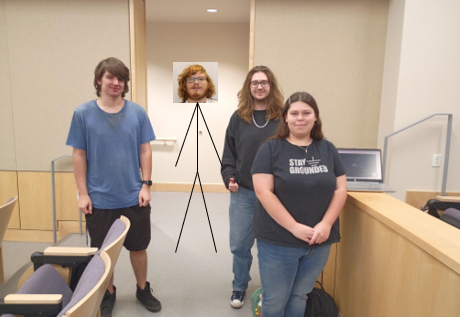
The team members from left to right are Kiefer Salak, Johnnie Williams, Brendan Biehusen, and Summer Morris.
Problem Statement
The client is a school system with a bus that transports books for children. The bus currently only has one way of getting on and off the bus. The only access point is a steep and narrow staircase at the front of the bus. It is difficult for younger children to enter and exit the bus with that method, which can be dangerous for those children. Likewise, it is difficult to leave the bus because the staircase is too narrow for bidirectional traffic. An alternative method of safely leaving the bus will allow more children to access the bus, which will further promote literacy in younger children. Since the bus is driven by one person, the solution must be transportable, lightweight, and sturdy.
Design Specifications
The solution must satisfy several design specifications to ensure that the design is able to be safely used and is functional.
Lightweight:
The design should be lightweight such that one person is able to move it.
Transportable:
The design needs to be transportable such that it can travel on the bus to various locations. The design shall also be separated from the bus, such that no permanent modifications are made that can damage the bus.
Structural:
The design must be sturdy enough to hold the weight of children in grade school.
Safety rails:
The design shall include rails and other safety mechanisms to keep individuals from falling off.
Fun:
The design should be enjoyable for children.
Background Research
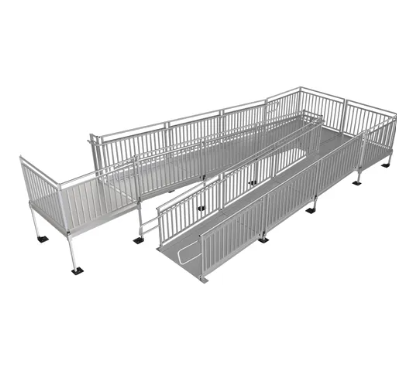
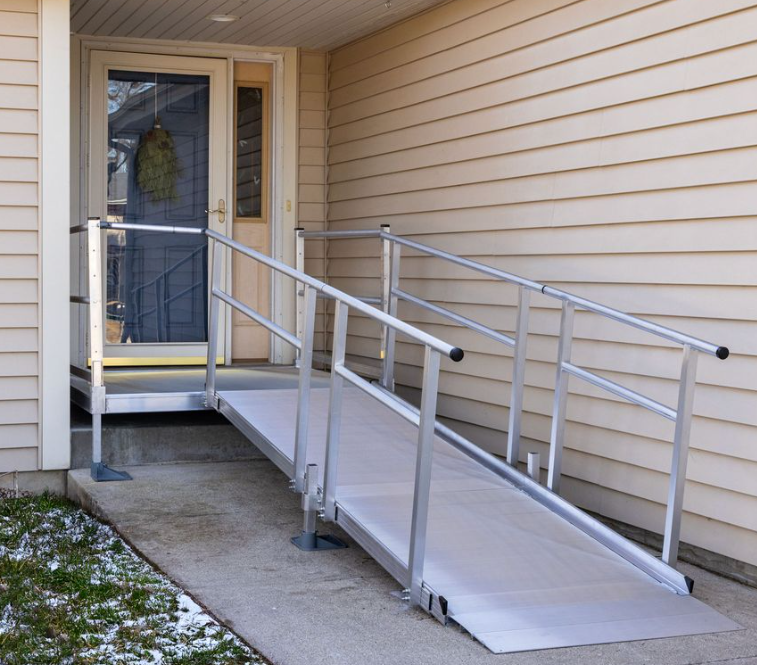
While researching this problem, many potential solutions were found that already exist. Ramps are one method used to get individuals off buses. However, ramps are expensive, not easily transportable, and are lengthy. Another method was a lift that can lift individuals on and off the bus. However, there needs to be an operator to run the lift, and the lift needs to be able to be secured in a nonpermanent way. A trampoline would be a fun method of getting children off the bus, as children would get to jump off the bus. However, a trampoline would be dangerous without safety measures. A slide, ladder, or stairs are some other methods of exiting that were found.
Our team investigated other aspects that will play an important role in our design. Some safety features used on designs include rails and textured material to keep people from falling off. Our team researched different materials including wood, steel, aluminum, and plastic. We compared different materials by cost, strength, and weight. We also investigated different methods of temporarily attaching our design to the bus. Some solutions we found include using magnets, clamps, a long board or pole, or creating a free-standing structure.
Note: All ramp images were taken from discountramps.com. The lift image was taken from galaxylifts.com. The slide image is from playgroundshadeandsurfacing.com.
Concept Design 1
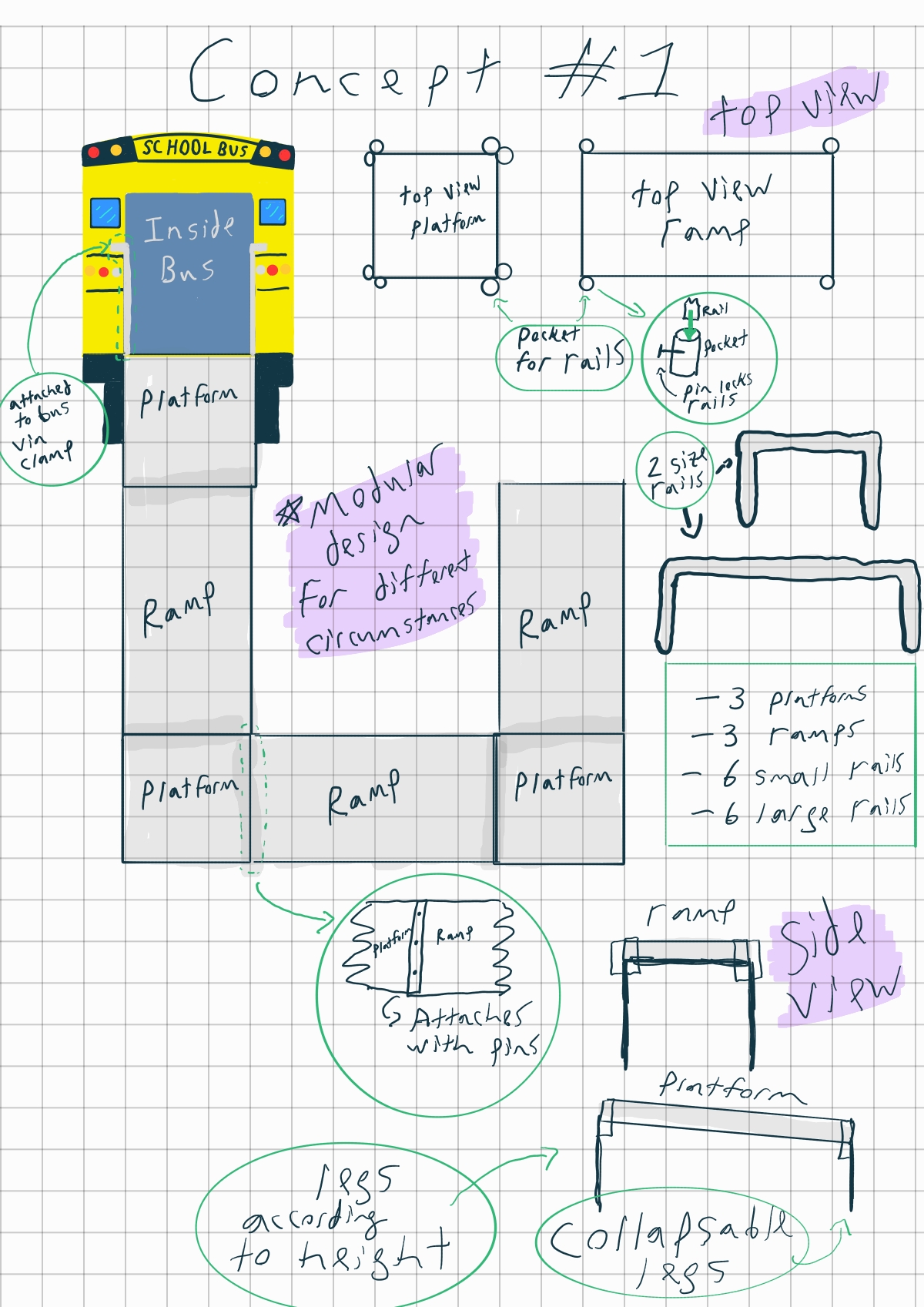
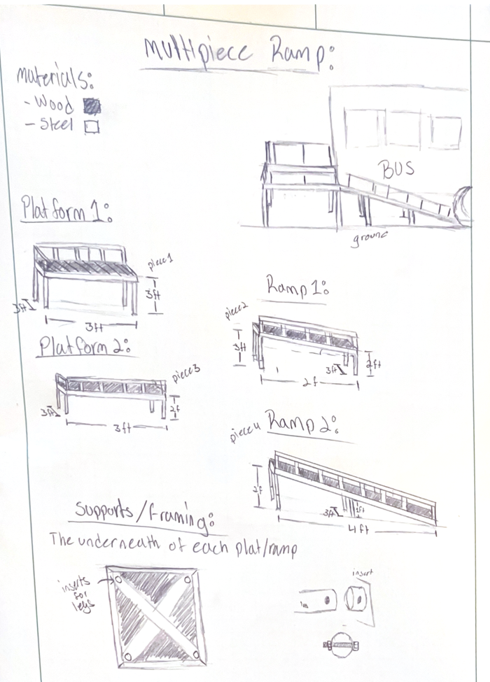
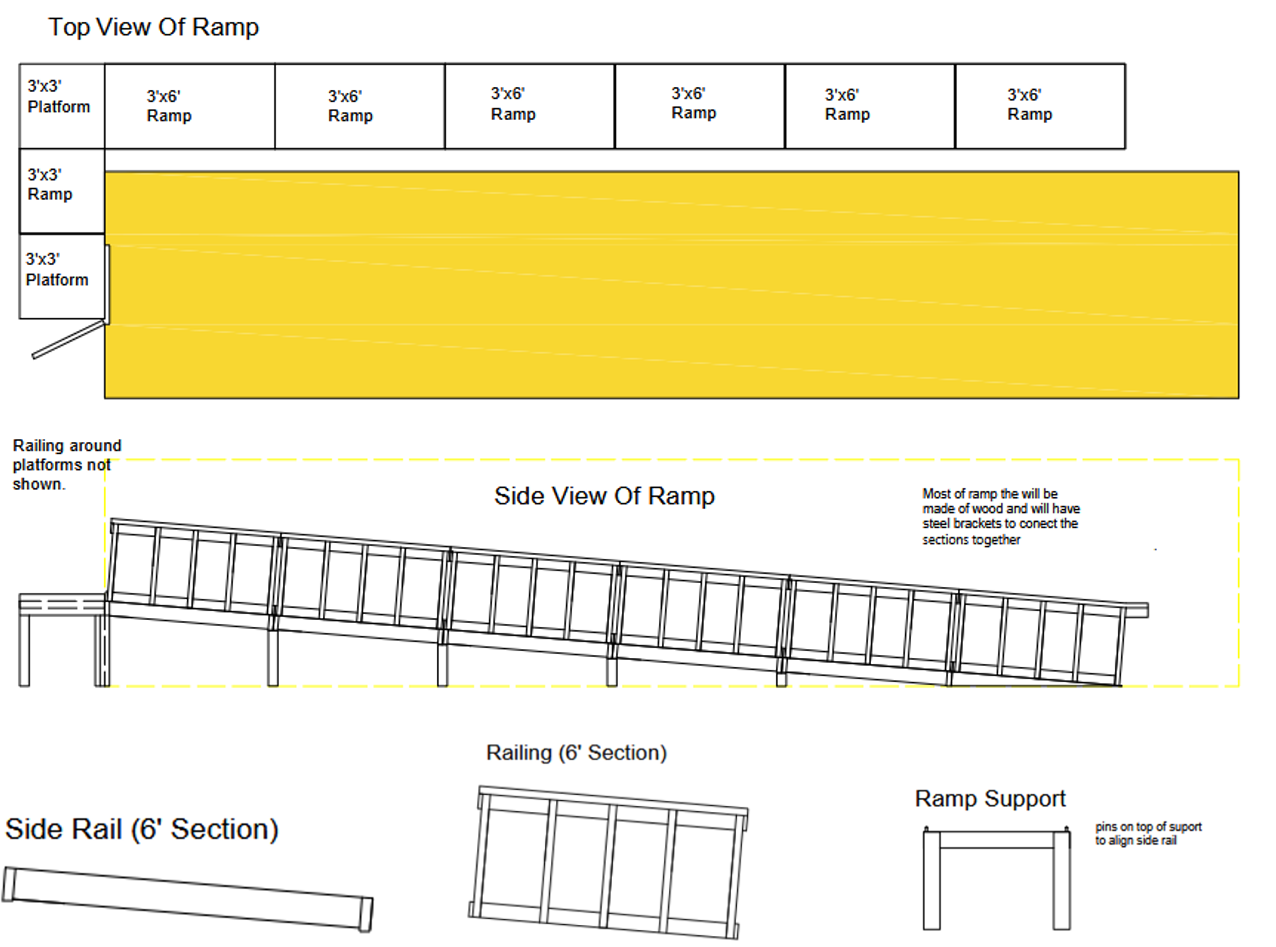
The first concept is a ramp. The ramp would include modular pieces to reduce the weight of any piece. Rails will be used to attach to the ramp to ensure individuals do not fall off. Platforms can be used to further break up sections, ensuring the design is not too heavy. The legs are removeable to ensure the ramp can fit on the bus after each use. Supports underneath the platform, as well as a mixture of material being used can help with strength and stability. The ramp is attached with either a clamp or some kind of locking mechanism to the bus. This will ensure the ramp is not permanent and can be taken down without damaging the bus.
Concept Design 2
The second concept is an object that will allow children to jump off the bus. The object will be attached to the bus with cables or rope that clamps or magnetizes to the bus. The object will consist of a trampoline, modified bounce house, or some kind of thick landing spot. Rails or some kind of safety net could be attached to the bus or bouncy object to ensure children do not fall off.
Concept Design 3
The third concept is a slide that attaches to a platform. The platform is on a sliding mechanism that allows the platform to slide back onto the bus after use. The platform is secured to the bus with clamps. The platform will also include rails as a safety measure. The slide will be able to detach from the platform for easy storage.
Selected Concept Design
Our team decided to go with design three. As shown in the design matrix, a slide would be less complex, lighter, more portable, cheaper, and safer than other designs. One issue with the slide would be ensuring the slide is stable enough to hold children, especially if the design cannot make any permanent modifications to the bus. However, supports and clamps added to the platform should solve this issue. A slide would also be more fun and more likely to encourage children to read. A bounce contraption would be too dangerous for children, and a ramp would be too heavy and costly. Thus, a slide would be the best solution for our problem.
Decision Matrix
Overview of Selected Design
Nonpermanent connection
A platform will be used to give children a stable location to get on the slide.
A clamp will be used to temporarily attach the platform to the bus without causing damage.
Beams will be attached vertically to the platform and will be used to prevent the platform from tipping due to weight.
Slide
The slide will be a manufactured slide similar to those found at a playground.
The slide will be attached to the platform with bolts that can be removed after use.
Safety rails
Safety rails will be attached to the platform to prevent children from falling off.
The rails will be custom built to fit the size of the platform.
Track
A track will be used to slide the platform outside while the slide is in use.
The platform will be able to slide back inside once the platform is done being used.
The track will consist of drawer slides on both sides of the platform.
Legs
The legs are rv support jacks that will be detachable, so that the platform can roll back inside after use.
The legs will provide extra support to the platform and will be adjustable to account for different terrains.
Describe Design Details
Several design features were incorporated to ensure the slide meets all specifications while being safe to use. RV support jacks will be used as the legs for the platform. This will ensure the legs can withstand a heavy load while still being removable. Part of the platform will rest inside the bus on the track. This will not only help support the load, but the platform will be easy to put up once it is done being used. The platform will be able to slide in and out of the bus instead of needing to be lifted onto the bus. Rails will be attached to the platform to keep children from falling off the bus. The rails will be custom built to prevent children of all ages from falling off. Clamps were chosen to attach the platform to the bus in order to ensure no damage is done to the bus. Clamps will help stabilize the structure and are less expensive than magnets.
Engineering Analysis 1
While working on our design, we came up with several options for the platform’s support legs. To help choose the best one, we wanted to ensure they could handle the forces of the platform when fully loaded with people. We considered three specific designs: a wood 4×4 post with a scissor jack on the bottom, an adjustable steel post with an adjustable foot, and a standard RV slide support jack.
For the first two designs, we calculated both the buckling and compressive loads. Since we couldn’t run those same calculations for the RV slide support jack, we went off the manufacturer’s weight rating instead. After comparing the results, we concluded that all the support legs are more than capable of handling our expected load. However, we found that the real weak points for these designs are the adjustable components at the bottom.
Engineering Analysis 2
When doing the analysis on the slide, a few assumptions were made. The expected weight was set to 150 lbf for a person that will use the slide. The chosen slide is expected to be 4 feet high and 6 foot long. The slide is connected to a wooden platform. By calculating the angle of the slide with respect to the ground, the force can be calculated for both the horizontal and vertical directions. The maximum internal bending moment was calculated to determine how much bending the board might experience. Next, the moment of inertia and bending stress was found. Lastly, the expected deflection was calculated. These values were compared with the maximum force allowed for a wood board and bolt. After comparing those values, it was determined that the slide will be able to withstand its expected load.
Engineering Analysis 3
An analysis was conducted on the backwall of the bus to determine whether the platform can support its load without the leg supports. This analysis assumes 40 lbf will be enacted on the wall of the bus by the platform. The maximum bending moment, maximum shear force, moment of inertia, bending stress, and maximum deflection was found. The calculated values were then compared with the bending stress that is allowable on a bus. According to the calculations, the bus should be able to support the platform without the extra leg supports.