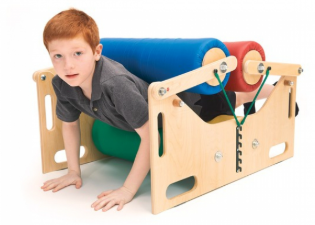
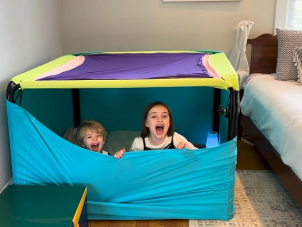
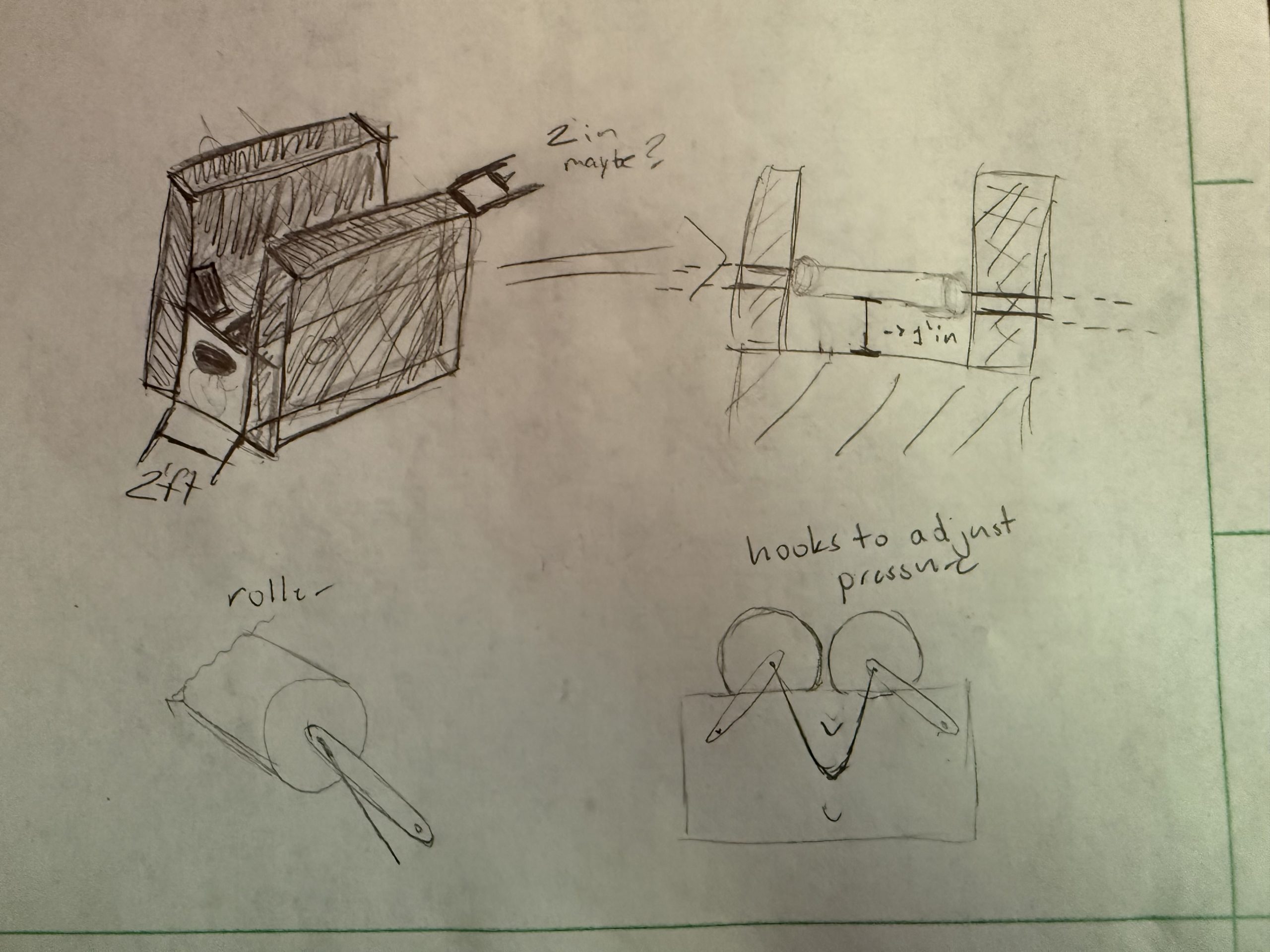
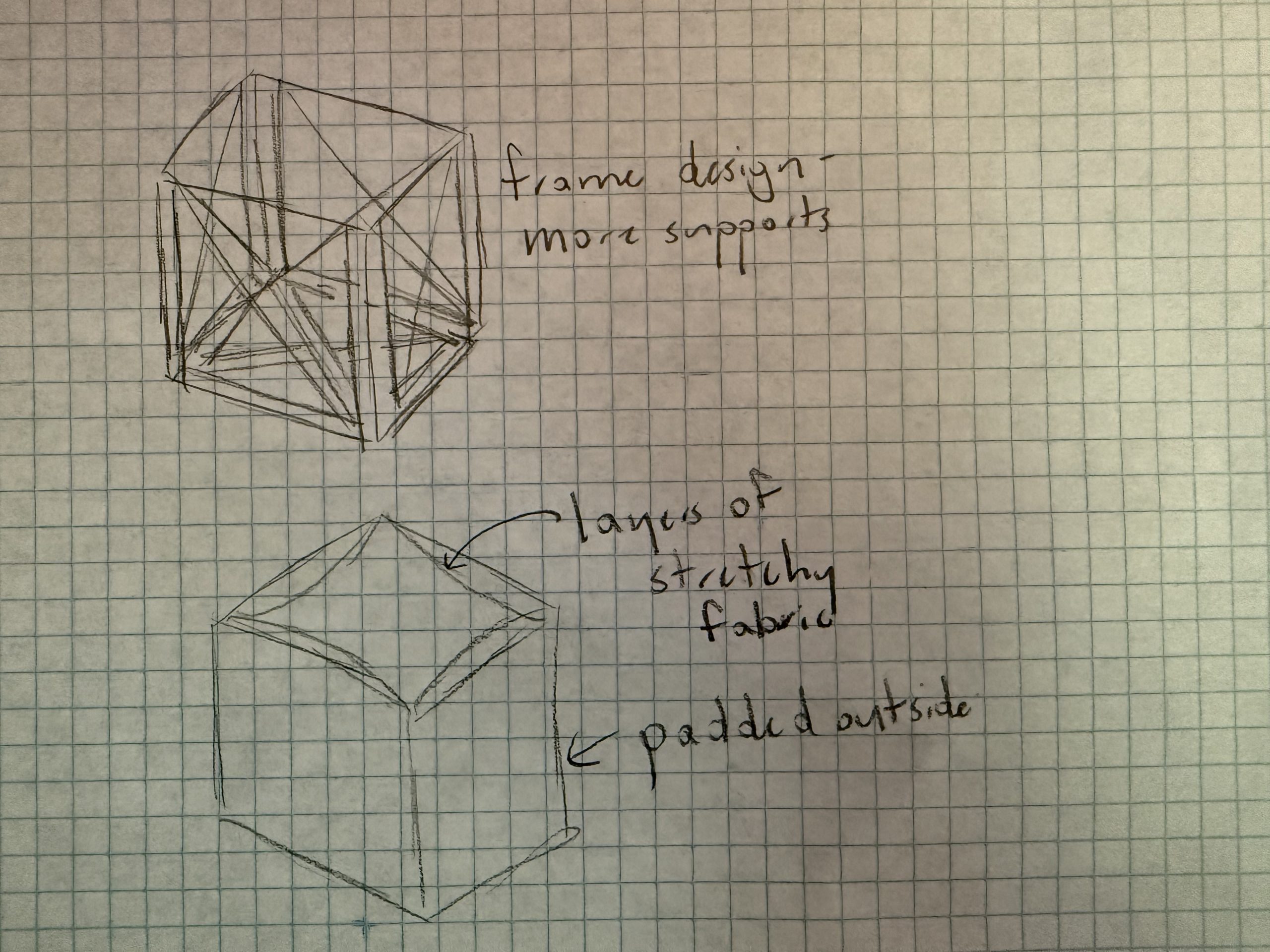
The clinic provides care for children with nuerodivergency. These kids have certain sensory needs that help regulate their emotions, and we have been tasked to provide toys that can do this. The cuddle box would provide pressure, vestibular (movement and balance), and tactile input through the stretchy layers. The steamroller would provides the same sensory inputs as the cuddle box. Both of these can help soothe a child, as they will allow the kid to have their stimulation needs met. We want to create a design that can meet these sensory needs, while allowing bigger kids to partake in the tools. Most of the designs online are intended for children under 10, but this clinic serves a variety of ages.
Design Specifications
Design Specifications for Steamroller
able to withstand rough handling
must be able to be wiped down
adjustable pressure
Design Specifications for Cuddle Box
able to withstand rough handling
fabric must stretch without tearing
removable fabric for cleaning
Background Research
There are a few designs of the steamroller and cuddle box online, and the clinic showed us what design they wanted. These designs tend to be meant for younger kids (under 10), but the clinic has a few teenagers who also want to participate in using these tools. The online steamroller has adjustable pressure, which will meet the various sensory needs for children who appreciate different amounts of pressure. The old steamroller broke, so we need to find more durable bands for the new design. The old cuddle box had mesh that was too big for the younger children, and their arms and legs would fall through the holes and cause issues. Both of the old designs were small, so sizing up would be preferable to allow the older children to participate.
Concept Design 1
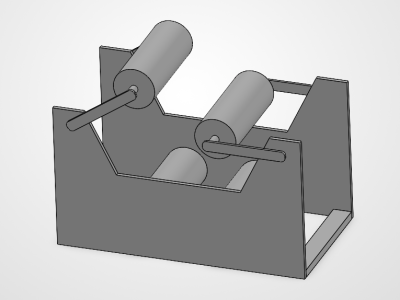
Our first design closely follows the designs we found online. Both the steamroller and cuddle box designs found online can hold a small child. We decided to keep the two separated, as the clinic had issues with the previous design that connected the two tools. For this design we would follow the dimensions of the designs online closely, and use similar materials as the ones listed online. This would be the easiest method, and the most tested method since these items have been sold numerous times and have been tested to ensure they are safe and reliable.
Concept Design 2
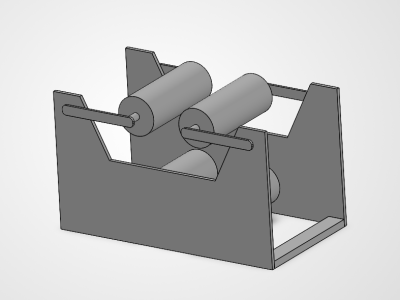
For this design we wanted to create something that would withstand a lot of rough play. The children at the clinic have been known to play rough, and a few sensory toys they had in the past were damaged due to this. Therefore, we essentially took concept design one and made it more resilient. This was done by adding thicker pieces of wood, using stronger materials, and reinforcing weak points. Along with this, we wanted the design to be useable by all the kids at the clinic. This meant we had to come up with something that could be used by a toddler and a teenager. To do so, we had to adjust the designs we found online, as most of them were intended for children under 10. The design features larger dimensions for the cuddle box, and the width of the pressure roller is longer so that all of the kids can fit through. We also wanted an adjustable pressure for the pressure roller, because one child may have a different pressure sensory preference compared to another. Adjustable bands were added with the ability to remove them, because we noticed that the ones listed online had extra bands to purchase. We did not want the bands to break and then the design be broken, so a replaceable band was an important design choice.
Concept Design 3
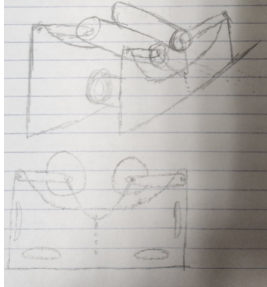
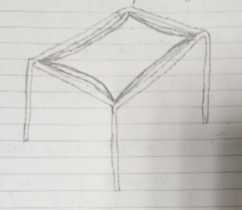
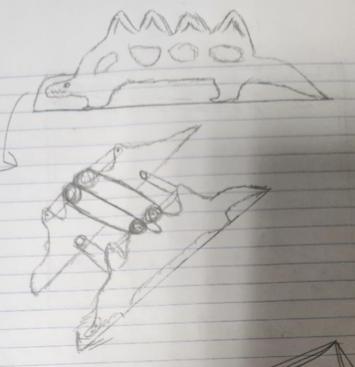
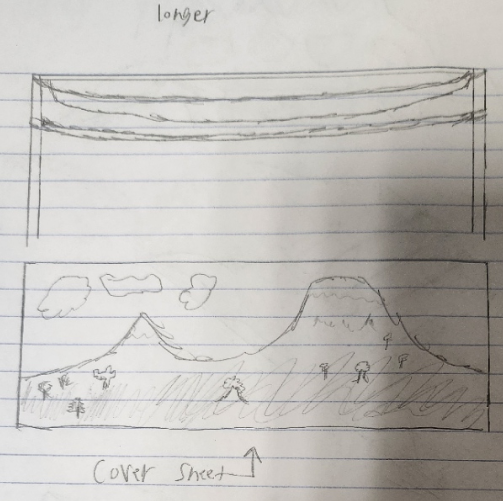
This design is more creative, featuring a dinosaur design. The structure would be somewhere between concepts 1 and 2, with a larger size to accommodate older kids and a larger safety factor to ensure it can handle the added weight. The cuddle box would also mimic concept 2 and be suitable for older kids, and this one would have a design on the outer fabric to make it more aesthetically appealing. We would use greens and blues as they are calming colors, and it would fit in with the forest/nature theme that the clinic already has. We would include adjustable bands with this design as well, and provide extra bands to the clinic so that they could replace the bands when needed.
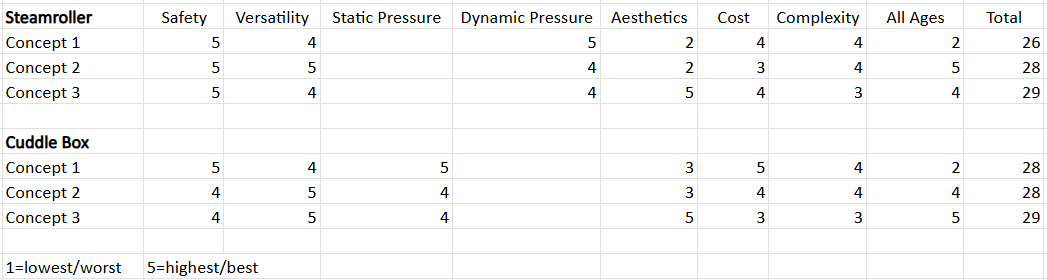
Decision Matrix
Overview of Selected Design
We decided to go with our third concept. It will utilize the stability of design one but have an inviting design, which will make the sensory mechanism more appealing to the children. The design will closely follow the sketch in concept three. It has the same function as a typical steamroller mechanism found online, with the outer walls adjusted to create the dinosaur design. Along with this, we decided to focus our attention on making the steamroller, leaving the cuddle box for another team in the future.
Describe Design Details
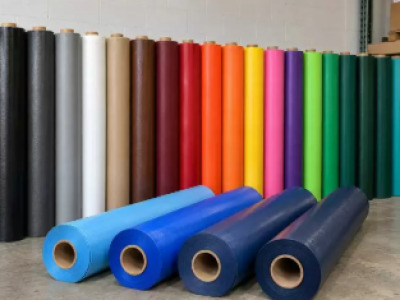
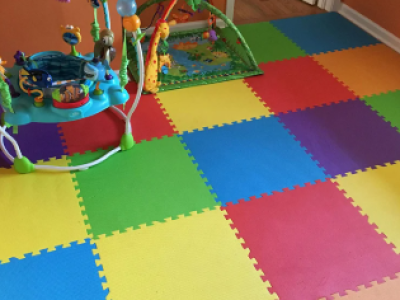
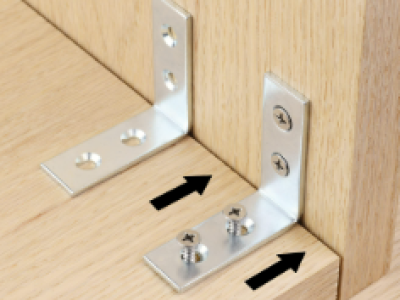
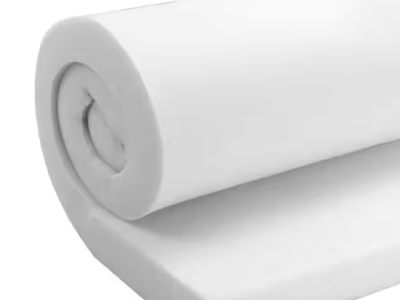
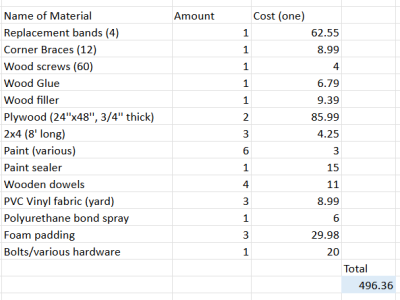
For this device we decided to balance aesthetics with functionality. We decided to use PVC vinyl fabric so the rollers can easily be wiped down. It is moisture resistant, highly durable, and low maintenance, which would be beneficial for a clinic with so many kids running around. This will wrap around foam that will wrap around wooden dowels, and the whole part will rotate so that kids can crawl through. There will be 2x4s for the framing, to add extra support considering the kids like to play rough and might not always use the device as intended. We are also going to use corner braces on the base/walls, to ensure it is stable and won’t wobble when used. We decided to add some foam to the bottom device, so that the kids can crawl through it and have added grip and padding to the floor. We will have adjustable pressure, using hooks on the side of the device. As the resistance band is pulled further down, the pressure will increase. Along with this, we decided to make the bands easily removable, as we heard from the clinic and other sources that they tend to get worn out/break. The bands get pushed past their elastic deformation into plastic deformation, which means that they will permanently deform. We can see that they show a nonlinear stiffening pattern, where the band will stretch easily at first, but as it stretches more it will become stiffer. This is good for our device, because it will allow us to adjust the pressure according to the child’s sensory needs. For aesthetics, we plan to go with calming colors like greens and blues, and add a dinosaur or two. We decided to paint the dinosaur onto the decide instead of cutting it out, to eliminate the amount of sharp corners and to make fabrication easier.
Engineering Analysis 1
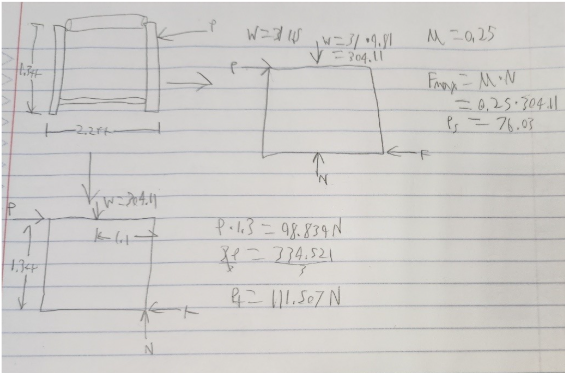
This analysis examines the forces needed in order to tip and push the steam roller given my equations it is shown that it would take a force of about 76.03 newtons or 17.09 pound force in order to slide the box and a 111.507 newton or 25.07 pound force to tip the box meaning that the box will slide before it tips over which is much safer. Additionally all these calculations are done without taking the child’s weight into consideration meaning that the actual system would be even harder to tip over
Engineering Analysis 2
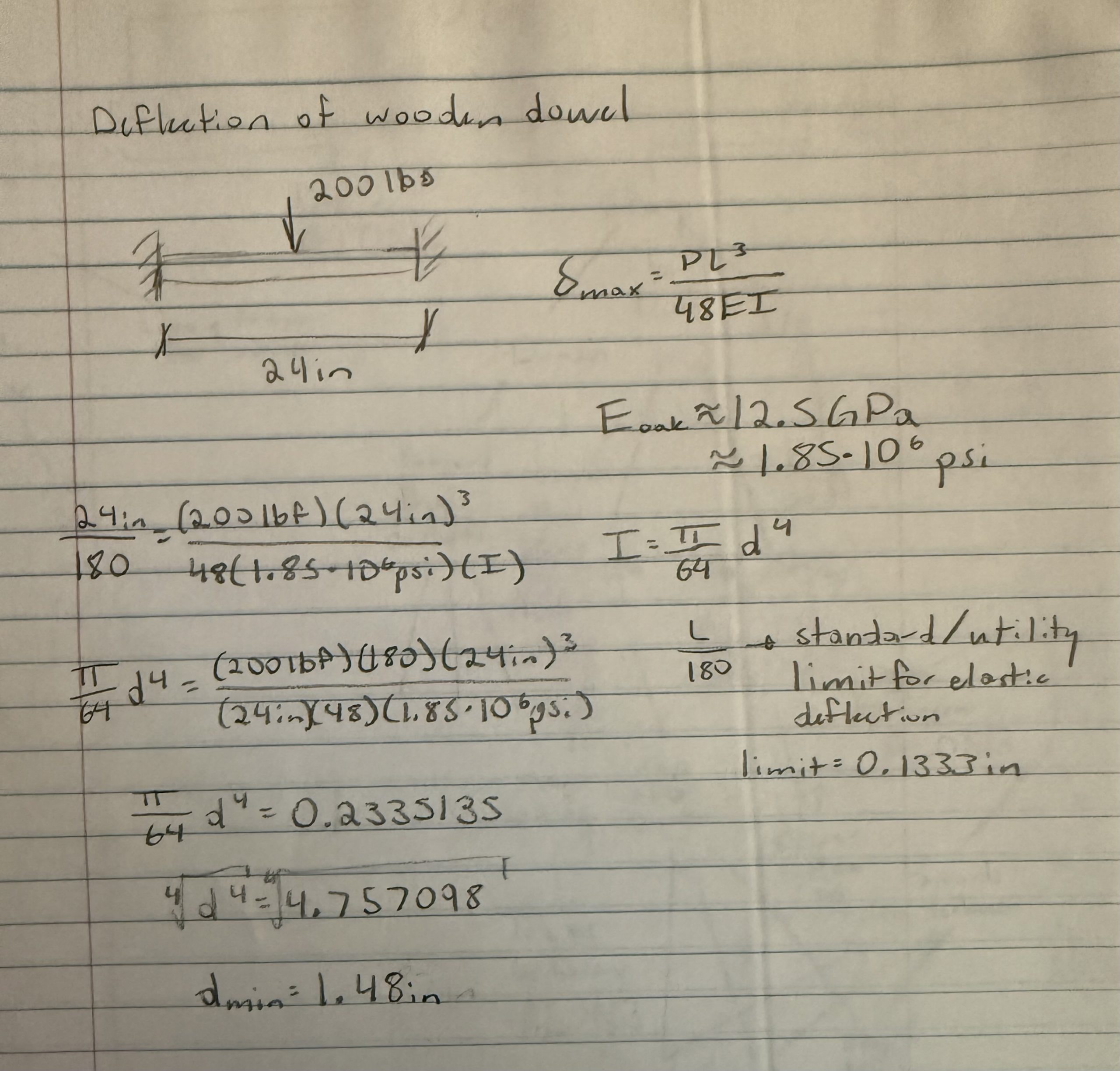
We were informed by the clinic that the kids they have like to play rough. We wanted to design to prepare for this possibility, so that this sensory device could be roughed up a bit and still work as intended. The ideal use of this mechanism would have the wooden rod experience a distributed load at a lighter weight. However, we wanted to ensure that if a child decided to climb on the mechanism, it would be able to support the child without breaking. To do this, we solved for the smallest allowable diameter of the wooden dowel. I found L/180 to be a common standard/utility limit for elastic deflection, which means the allowable deformation would be around 0.133 inches. Using the corresponding deflection equation for this beam type, I found that the minimum allowable diameter would be 1.48 inches.
Engineering Analysis 3
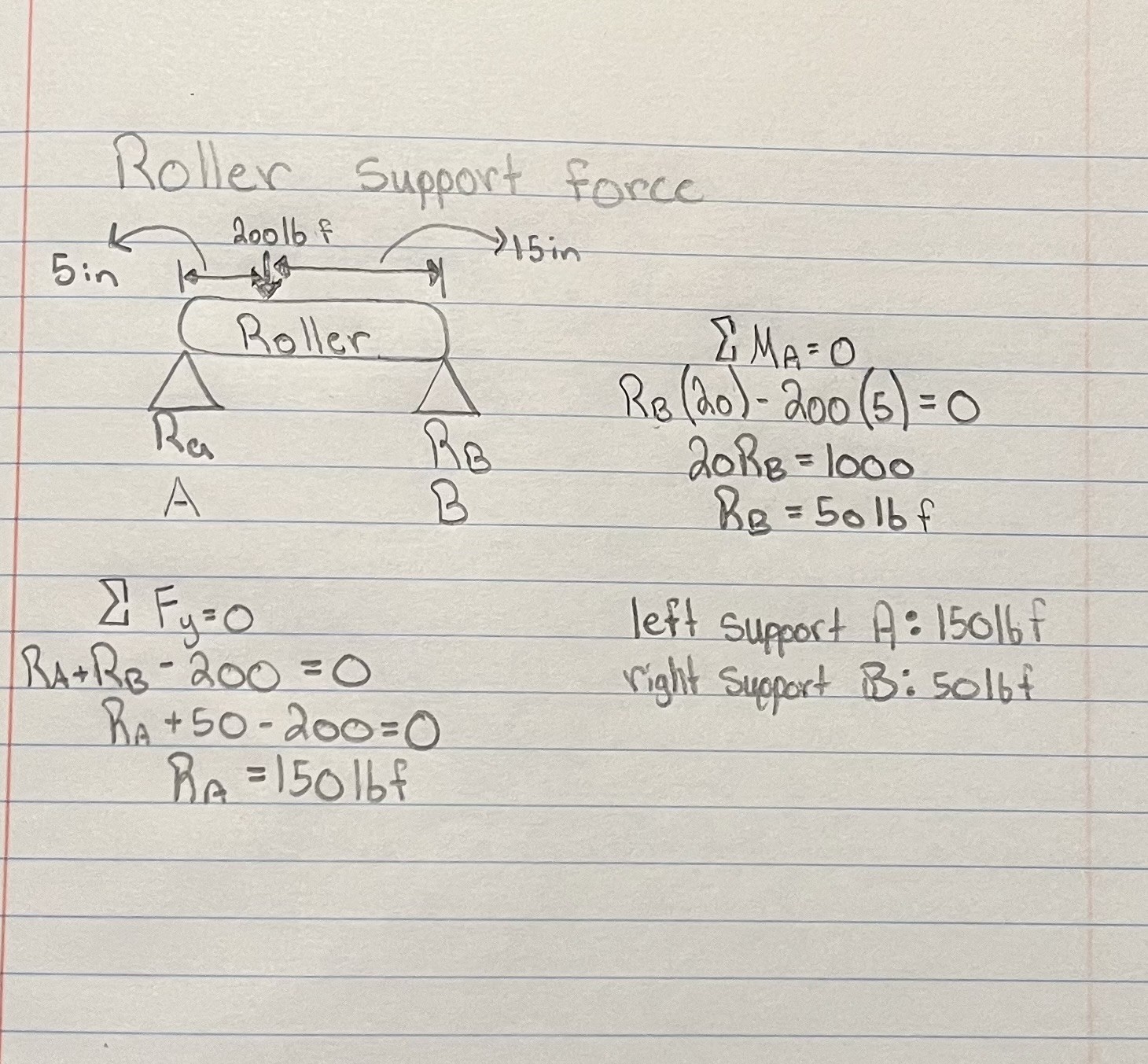
This analysis examines how a downward force applied to one of the steamrollers is distributed between the two supporting side panels. Since a child could apply pressure at different locations along the roller, we’ll be applying the principles from statics assuming that there is a 200 lbf downward force that is applied 5 inches from the left side of the roller along the 20-inch roller. When applying the moment equilibrium equation, we can calculate that the force of 50 lbf at the right support. Then by using the vertical force equilibrium we can calculate the force of 150 lbf at the left support. These results demonstrate when forces are applied closer to one side of the roller and understand how the steamroller responds to uneven loading.