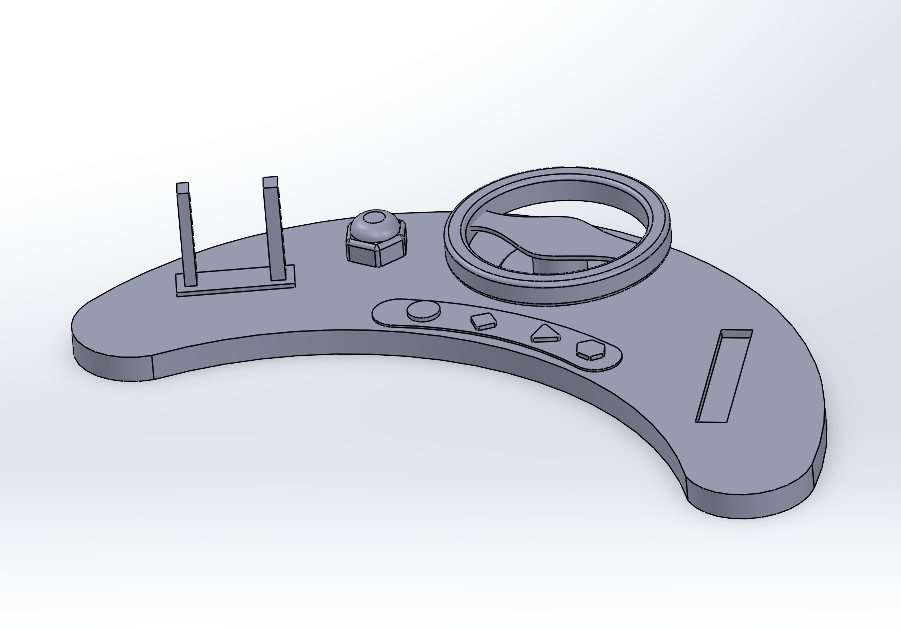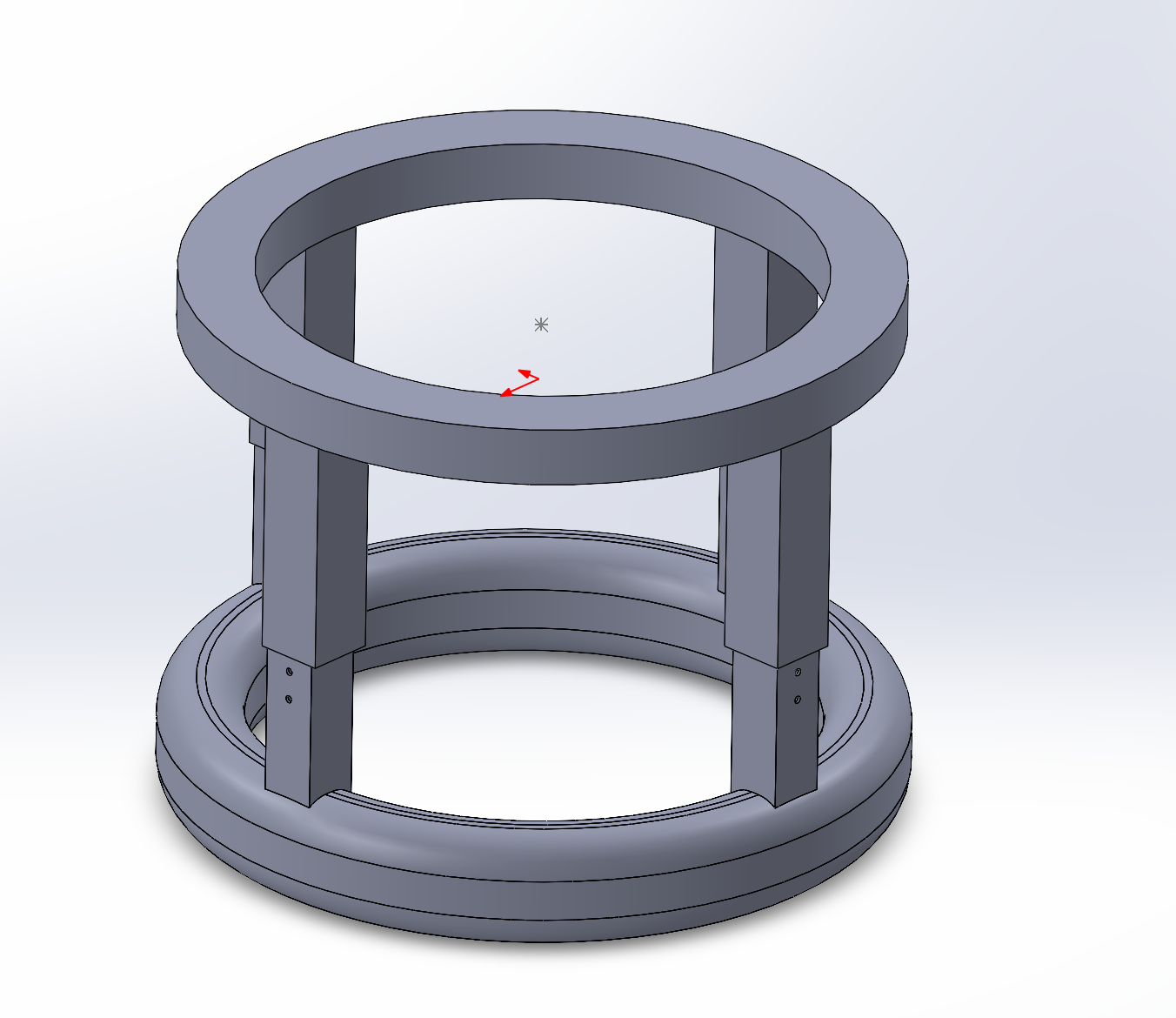
Our group was tasked with designing and building an activity jumper that grows with a child by providing adjustable and adaptable features to fit their changing needs.
Our project focuses on redesigning a jump seat to help a child improve stability, comfort, and independence while accommodating her needs as she grows. The design will include adjustable height, a washable seat, and a multifunctional table for feeding and sensory activities, along with interactive toys, lights, vibrations, and an iPad mount. The goal is to create a safe, adaptable, and engaging design that supports the child’s daily activities, sensory needs, and communication.
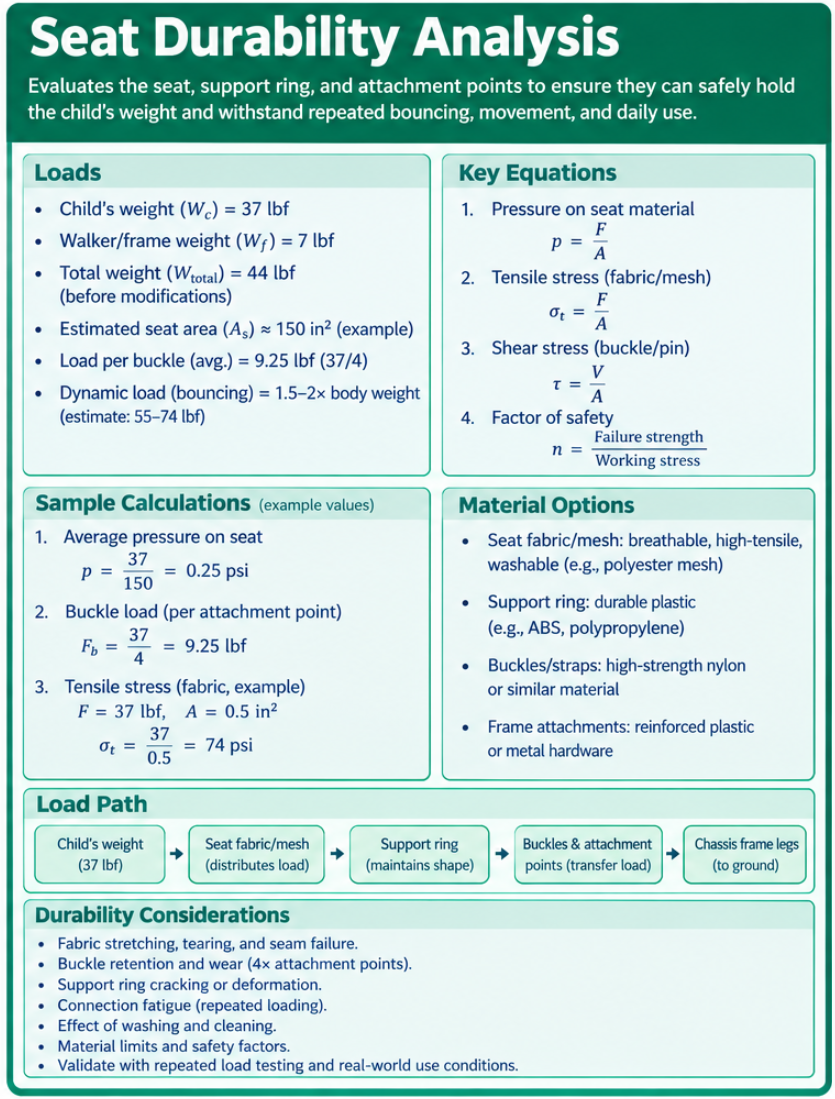
The chassis will be redesigned to allow for adjustable height as the child grows. The structure will also be reinforced to provide greater stability and support increased weight over time. The table and sensory board will be modified to better accommodate the child’s developmental needs and interests. The design will incorporate adaptable sensory activities and interactive features to encourage exploration, engagement, and learning. The goal is to create a more personalized and versatile space for the child to play and interact with her surroundings. The seat will be redesigned to incorporate a bouncing motion while improving comfort and adaptability. This feature will allow the child to bounce and move naturally while using the activity jumper. The seat will also be designed to better accommodate the child’s growth, providing appropriate support and allowing the product to remain useful as the child develops.
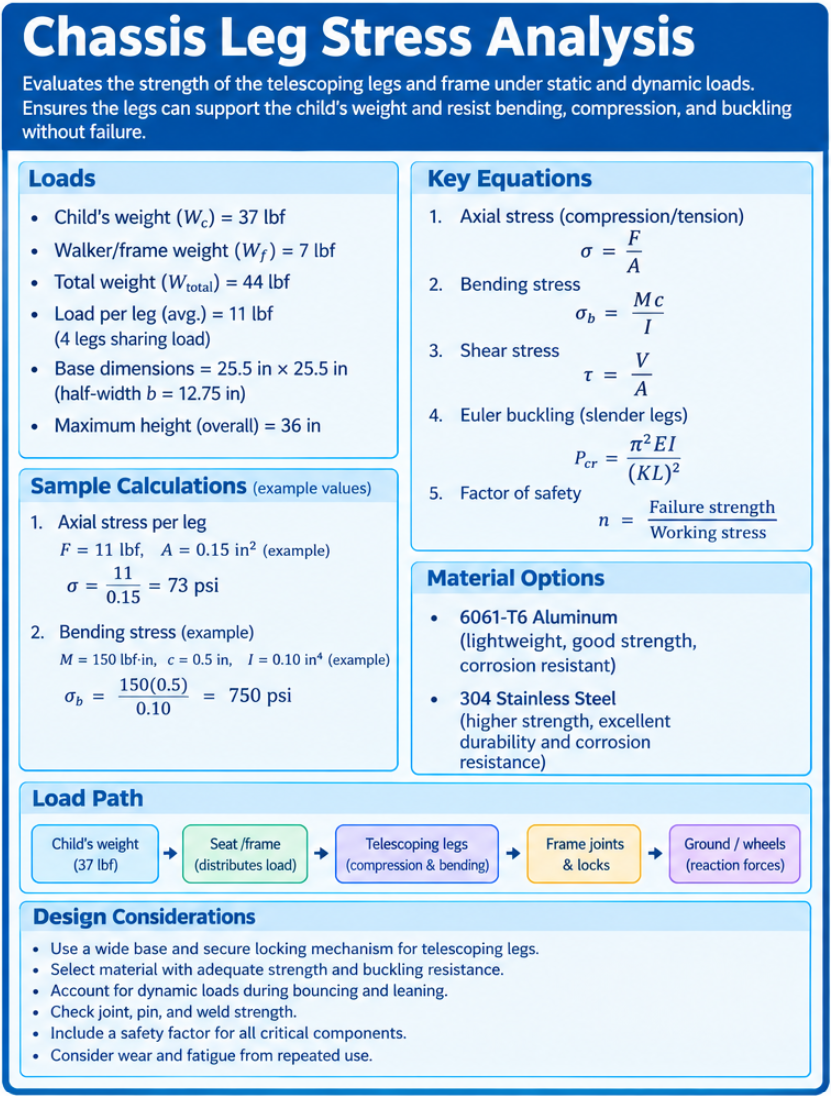
Base Length- 25.5in
Base width- 25.5in
Maximum overall height- 36in
Walker weight-7lbf
Child’s weight-37lbf
Combined weight, before modifications-44lbf (not including additional toys, seat, electronics/other accessories)
Half-width of base-12.75in
Half-length of base- 12.75in
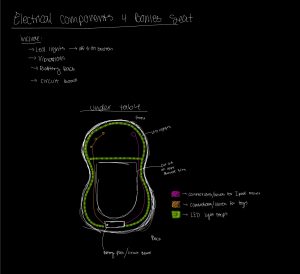
Several areas of research are needed to develop our redesigned for are seat. First, we need to research material strength and selection to determine which materials can safely support the child as she grows while maintaining the stability and durability of the chassis. Second, we need to research electrical circuit diagrams to understand how to safely incorporate lights and vibration features into the sensory board. Finally, we need to study force distribution throughout the system to understand how the child’s weight is transferred through the seat and chassis to the base. This research will help us make informed design decisions and improve the overall safety, stability, and functionality of the redesigned activity jumper.
For Concept Design One, we gathered information about the needs and preferences of the child and her family. Using this information, we created an initial rough draft of the design, which served as the foundation for developing our final concept.
Our second concept design was heavily based on a baby walker we found online. One of the main features we incorporated was the scissor-lift mechanism located on the sides, which allows the height of the seat to be adjusted as the child grows. We used this concept as a starting point and adapted it to better meet the specific needs of the child especialy as she grows, while leaving room for additional features such as sensory activities, a feeding tray, and an iPad mount.

Our third design uses telescoping legs to provide greater adjustability and support as the child grows. This mechanism allows the seat height to be easily modified to accommodate the child’s changing size and needs over time. Additionally, the design maintains the ability to fold down into a compact form, making it easier to store and transport when not in use. Overall, this design offers a practical balance of adjustability, stability, and convenience while meeting the long-term needs of the child and her family.

We ultimately chose our third concept as the final design because it offered the best combination of adjustability, comfort, and functionality to meet the child’s specific needs. The telescoping legs allow the seat height to be adjusted as the child grows, while also allowing the design to fold into a compact form for easier storage and transportation. We also incorporated wheels with locking mechanisms to provide mobility when needed and stability when the seat is in use. The interchangeable table allows the design to serve multiple purposes, including feeding and sensory play. Additionally, we plan to include toys and interactive features tailored to the child’s interests and preferences to make the design more engaging and enjoyable. Overall, our final design focuses on creating a safe, adaptable, and practical solution that supports the child’s comfort, independence, and development while accommodating her changing needs over time.

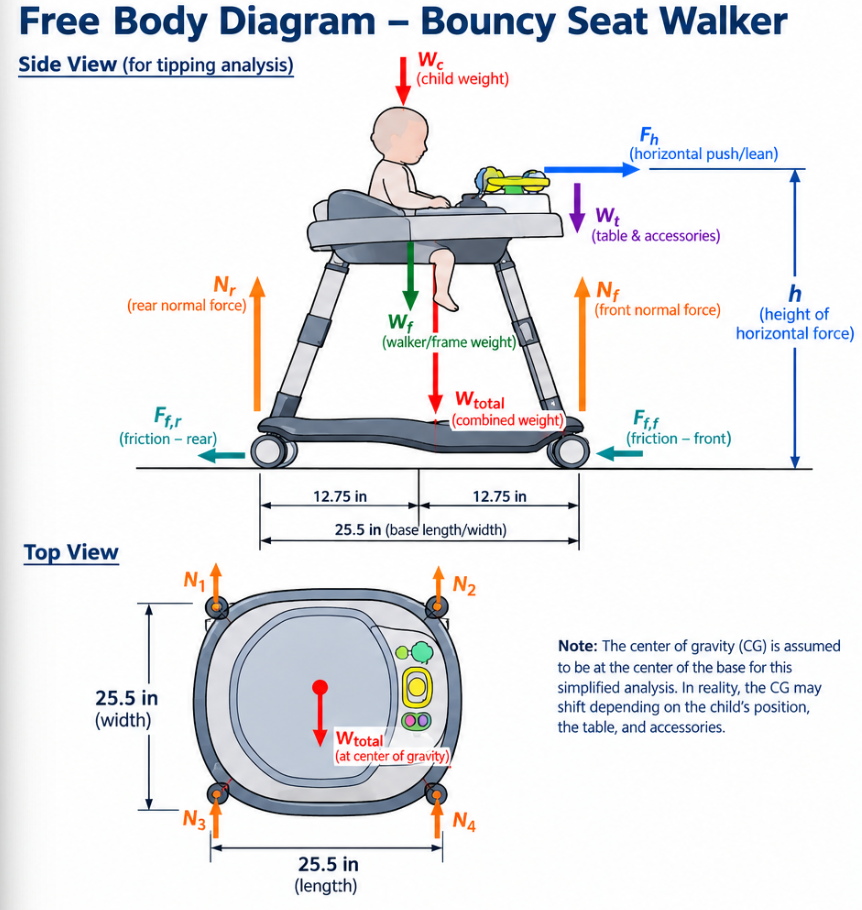
Tipping analysis:
Stationary Walker
∑ Fy=0
∑ Fx=0
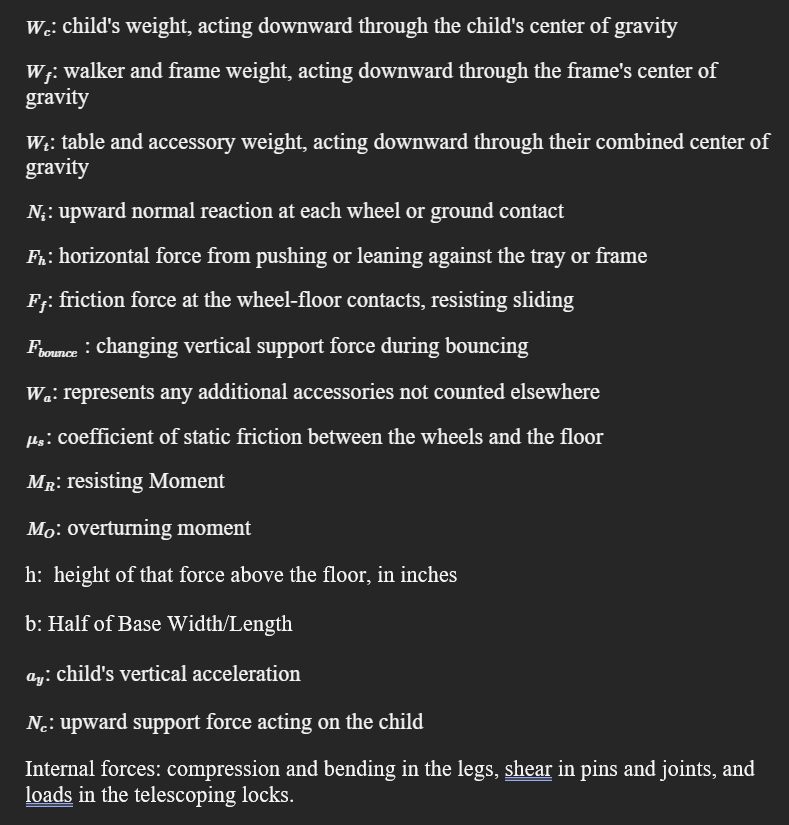
∑ Ni=Wc+Wf+Wt+Wa
∑ Ni=37+7=44lbf
-ignoring bounce and assuming only child and 7lb walker
Ff,max=μs ∑ Ni
Moment Equilibrium
∑ M=0
Tipping moment (For 25.5in x 25.5in Base)
MR=Wtotalb
MR=(44)(12.75)
MR=561 lbf∙in
Horizontal force applied to the tray
MO=Fhh
Tipping Boundary
∑ jWj(b−xj)=Fhh
Child pushing down on table adds Vertical Force P, applied at xp
MP=P(xP−b)
Dynamic Loading During Bouncing (upward as positive Direction)
Nc−Wc=mcay
Nc=mc(g+ay)
Nground −Wtotal =mtotal ay

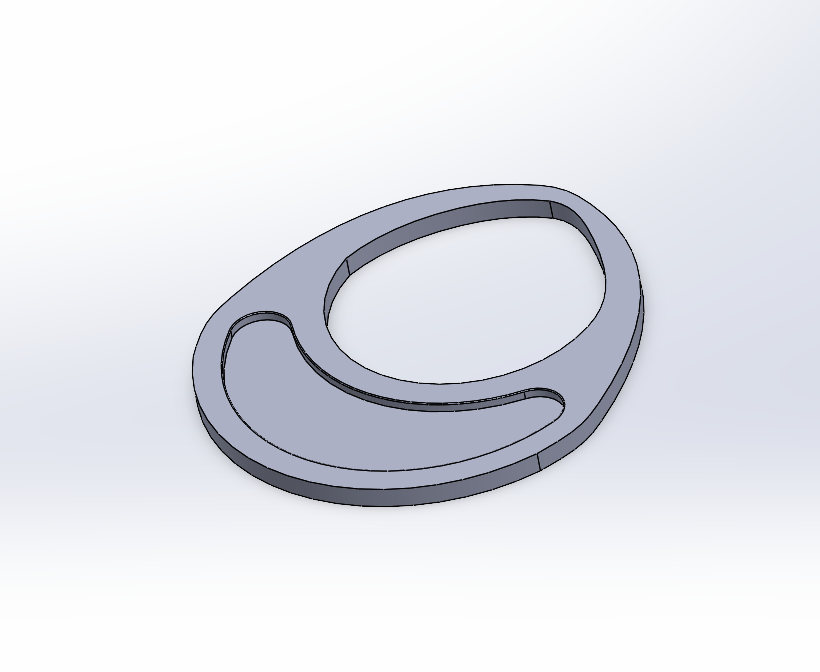
The fabrication process will be divided into three main subsystems: the chassis, the table/sensory board, and the seat. Each subsystem will be redesigned and modeled separately before being assembled into the final product. Our main design considerations will be stability, durability, adjustability, comfort, and the child’s developmental needs. The chassis will be redesigned to be adjustable vertically as the child grows. We will develop a frame with adjustable legs and appropriate locking features to hold the selected height securely. The redesign will focus on increasing the strength, distributing the child’s weight evenly, and maintaining stability throughout the adjustment range. The table and sensory board will be redesigned to provide more suitable interactive features for the child. We will create a tabletop that can accommodate sensory toys and activities, along with designated spaces for lights and vibration components. The design will consider accessibility, ease of cleaning, secure component attachment, and the arrangement of interactive features. The seat will be redesigned to provide a bouncing motion while accommodating the child’s growth. The fabrication process will include developing the seat structure, support connections, and bouncing mechanism. Once the three subsystems have been designed, they will be assembled into a complete CAD model. We will check that the adjustable chassis, sensory board, and bouncing seat fit together and do not interfere with one another. Selected components will then be fabricated using 3D printing where appropriate, while other components may require separate materials or manufacturing methods.