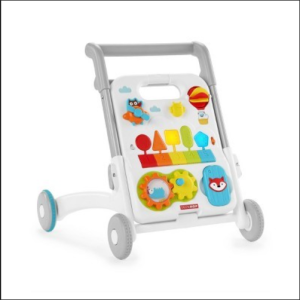
Simple push-behind walkers for toddlers found at retail stores do provide the supportive assistance intended for our design but are cheaply constructed and have little to no customizable features to accommodate growth of the child. The parent mentioned these models are not properly sized for the child and have had issues tipping over.They do incorporate interactive features which make the product more appealing to a child who otherwise might avoid using it.
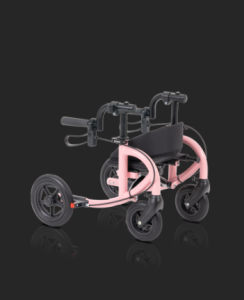
Rehabilitation companies, such as HOGGI, provide products with more robust design features like collapsable frames, height adjustment, and braking technology. The larger wheels are designed for safe use outdoors. Rugged design and increased structural integrity are important to our design process to create a product that is safe and long-lasting.
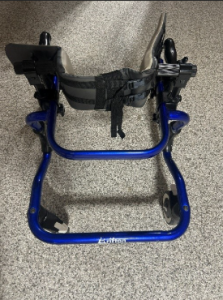
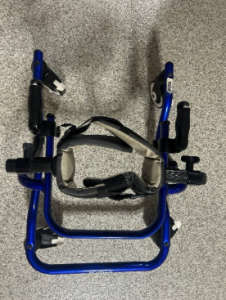
The current gait trainer used by the child utilizes an open front with an abdominal saddle for extra support and right/left handlebars. The parent informed us that the placement of the handles did not displace weight in a manner that allowed for enough mobility and that there was a general dislike towards using the trainer, especially after removing the saddle. Our conceptual designs seek to keep the structural integrity of this design and overall stability while avoiding the features mentioned that do not seem to be functional for the child.
This design adapts an existing walker to support the child’s growth and mobility. The handlebar and the linkage between the front and rear wheels are telescoping, allowing the frame to adjust as she grows. A pivot mechanism ensures that when the handle extends and the geometry changes, her weight remains within the wheelbase for stability. The front wheels are redesigned to enable turning, and a support brace is added to evenly distribute the load across all wheels. Additionally, the front panel incorporates a wooden peg board for interchangeable toys, encouraging engagement and play.
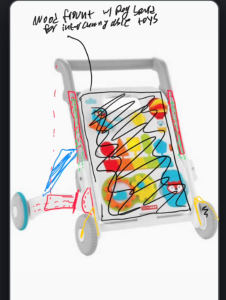
Unlike a traditional gait trainer, the walker is positioned in front of the child and does not require a harness or enclose the user, allowing for greater freedom of movement and independence. The design features an adjustable lightweight frame that can grow with the child, ergonomic handles, and durable wheels capable of handling both indoor and outdoor surfaces such as sidewalks, grass, and playground areas. The goal is to create a safe, stable, and practical mobility device that provides support while allowing the child to interact with her environment more naturally.
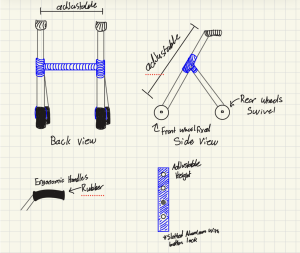
This design focuses on improved stability featuring a wraparound base-frame, wide rear-wheel base, and a handlebar that doesn’t extend past the base-frame. This also incorporates a collapsable frame, making it easily portable. Swiveling wheels in the front allow for increased mobility.
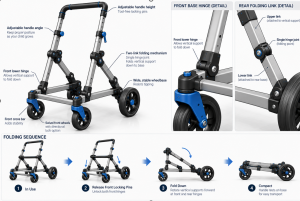
*image generated using ChatGPT and used to display design features. This DOES NOT represent a final product.