Our team was tasked to create an all-including sensory play set to keep a 3-year old boy diagnosed with autism and his younger sister with sensory needs entertained in spite of their short attention spans. Our design focuses on incorporating a variety of fun and engaging mechanisms that would appeal to a child with autism while maintaining safety in the play area.
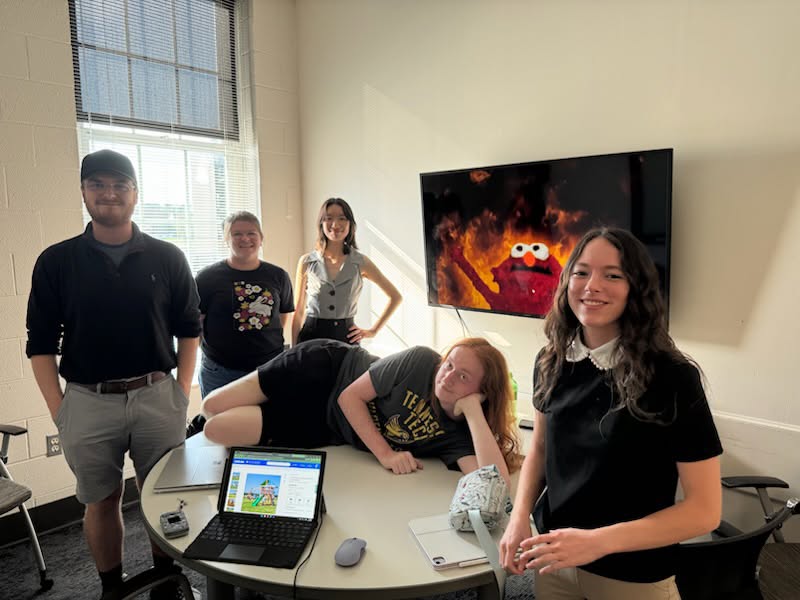
Team Members (left to right): Jonathan Ivey, Whitney Leftwich, Emily Yang, Mason Waldron, and Reese Morrison.
Problem Statement
The participating family has requested a play set for their children specifically designed to address short attention span and sensory needs. They specifically requested a slide, pair of swings, and sensory elements, in addition to as many different features and functions as possible to keep the boy and his sister engaged. The children exhibits love for high-intensity play, including climbing and tactile exploration, therefore it is pivotal to provide them with a dedicated space to express their natural curiosities. Our playset must accommodate this family by promoting both the extra motor development, sensory processing, and social interactivity that the children need.
Design Specifications
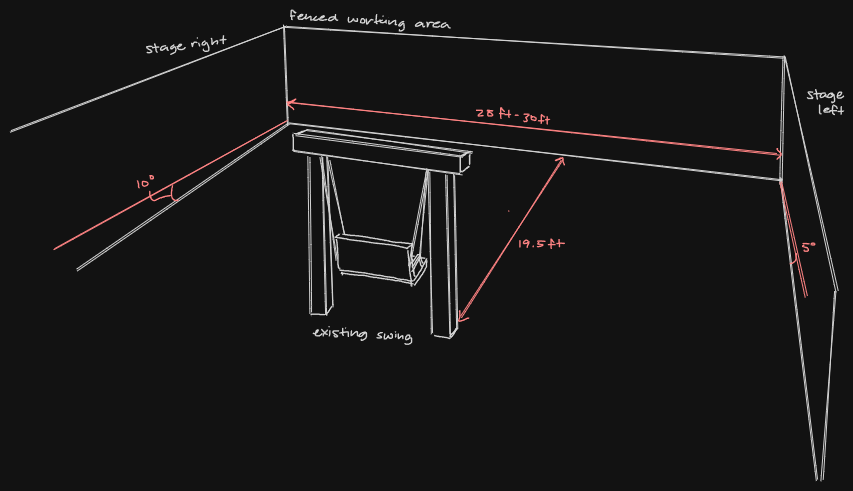
The rough dimensions of our working area are as follows (image provided as visual reference):
For our ease of mind when operating on the family’s property, we confirmed that there were no pipes underground to be wary of.
Background Research
For our project, the background research focused on researching existing play sets that aligned with the family’s requests, ideally including a slide, swing set, and climbing apparatus. By purchasing a product that was predesigned for commercial sale, we could ensure that the framework of our play set sits atop one that already meets the standard safety requirements.
To customize it for children with special needs, we looked through common sensory attachments as well as non-traditional sensory features to enhance the children’s play experience. The primary focus of these additions is to provide a wide variety of interactions to diversify creative, social, and developmental outlets. Playset elements should grow with the children, and be repeatedly usable as they age (target age ranges from 3-7 years old).
Additionally, various materials were evaluated to ensure the final design would be durable and could stand up to local weather.
Concept Design 1
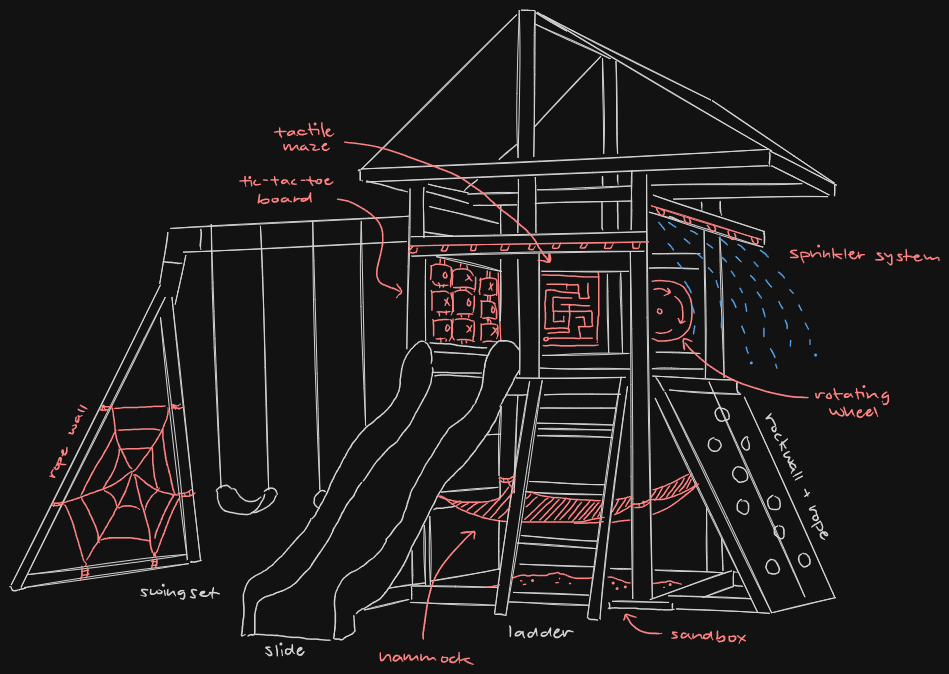
This design is based off a pre-existing playset that features a slide, swing set, and a rock-wall (existing elements shown in white). The playset specifications are listed below:
Dimensions (L x W x H): 13’ 6.5’’ x 12’ 6.5’’ x 9’ 11.5’’
To customize this playset to the family’s needs, the upper platform’s walls can be transformed to include a Tic-Tac-Toe board, a tactile maze, and a spinning wheel. A webbed rope wall is tied to the side of the swing set for climbing, and a play area with a hammock and sandbox are included below the playset. A sprinkler system runs along the top railings to provide cooling during hot summer months. (alterations shown in red)
Concept Design 2
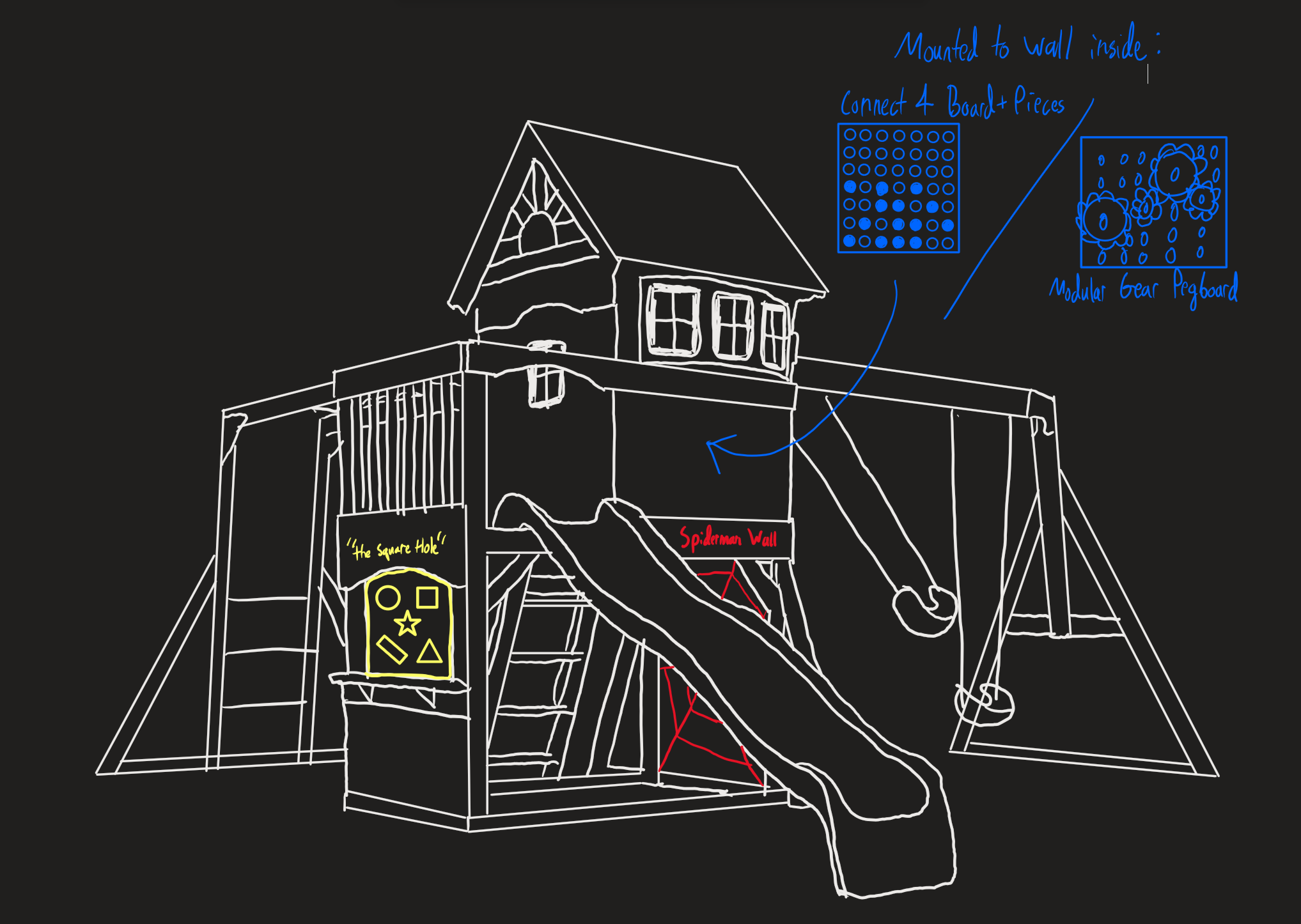
This concept design is a alteration of a Costco Swing Set, which contains a slide, swings, monkey bar, stairs, and an upper floor.
To customize the set to the family’s needs, various interactive toys have been added, including: Connect 4 board, module gear pegboard, Spiderman rope wall, and cutout shapes wall.
Concept Design 3
This sketch is based off of the playset linked below. Its features include a slide, swing set, chalkboard, and rock wall.
This design adds features to the playset to better engage the siblings’ attention span and fulfill high-sensory needs, including a sandpit, climbing net (with side wall removed), spinning tic-tac-toe wheels, sprinkler system, spinning marble maze, and gear wall.
Selected Concept Design
Our team decided to use Design 3 as our final concept design. It includes a variety of different sensory play elements to engage the children’s attention-span, and allows for both gross and fine motor activities like climbing and spinning that can be done in a safe and controlled environment.
Decision Matrix
Overview of Selected Design
The pre-existing foundation of the selected design is the Buckley Hill Swing Set, which provides the base components (swings, slide, slanted rock wall, chalkboard) of the family’s requests at a reasonable price point. It serves as a solid starting-point, but will need to be heavily modified for increased versatility.
The rightmost wall of the playset will be removed, and a climbing net will be added so that the children can climb onto the platform.
A Tic-Tac-Toe board will be added to the back wall, which will be 3D printed out of PETG HF and rotate about aluminum dowels.
The back wall will also include a gear board, which consists of a ring gear surrounding five planets and one sun gear. They will be mounted so that rotating the ring gear would articulate the entire structure. This will also be 3D printed in the same material as the Tic-Tac-Toe wheels.
A spinning wheel maze will be included, with the maze pattern cut out from a thick acrylic sheet and sandwiched between two solid layers. A marble will be trapped inside, and can be maneuvered via rotating the maze.
Finally, the base of the playset will be turned into a sandpit, which will provide a calm space for the siblings to play together and collaborate.
Describe Design Details
Detail #1: Gear Wall
We have designed a planetary gear system to provide the children with a tactile element to play with. This will promote both visual and sensory stimulation. It has one sun gear meshed with 5 planet gears, all mounted on a weather-treated plywood backplate. This provides fantastic feedback for the children and can help with their motor skills.
We started out wanting to do a straight line of gears, then thought that wouldn’t be enough to stimulate the children into using it on a regular basis. We contemplated adding a light that would turn on when the kids spin the gears, but we ultimately decided to go with the planetary gears because they are visually stimulating without the need for electric wiring in a non-weatherproofed location.
Detail #2: Tic-Tac-Toe Board
We are adding a Tic-Tac-Toe Board to provide the kids with more mental stimulation. They will be able to play against each other, providing opportunities to problem solve and a light-hearted competitive environment. The board features a 3×3 grid with rotating X/O pieces that will mount on a pole and rotate independently of the other pieces. The pieces will be 3D printed with weather resistant plastic and the letters on each piece will be recessed so that there is tactile feedback.
We originally debated if this was worth adding or not, but we decided that it was because of the interactive and re-playablility. We had thought of doing a “Connect 4” style game instead, but we decided to go with Tic-Tac-Toe because there wasn’t the worry about losing pieces.
Detail #3: Spinning Wheel Maze
We will put a spinning wheel maze on the other side wall of the playset. This will provide them more mental stimulation, but in a more cooperative environment rather than a competitive one. This will help the kids work on the teamwork skills and bond together as siblings. The maze will be cut from a acrylic sheet with a backing and faceplate. It will be mounted in a way such that the kids can rotate it to solve the puzzle. There will be a marble inside the maze that the kids will be able to move with the assistance of gravity.
We had debated between this type of maze and a stationary maze where they move the piece itself rather than the maze. We decided to go with the rotating maze because it’s more stimulating mentally and there’s more replay value.
Engineering Analysis 1
This analysis will focus primarily on the planetary steering wheel on the Sensory playset project. The gearset will be mounted in the upper section of the playset where other sensory items will be. The device combines an interactive gear mechanism with a steering-wheel-like interface, allowing the exposed gears to be spun by hand.
The content in this document will focus on how the gears interact with one another, along with how forces are transferred between meshing gear and whether the gear teeth and supporting components can withstand the forces associated with repeated use. One important note is making a usable gear interface for young children to use it with little flaws. The herringbone tooth geometry will also be examined on how it affects the forces acting on the gears and their supports.
This analysis will evaluate the potential materials for the wheel maze, tic-tac-toe assembly and a planetary gear fidget proposed for an outdoor playground. Factors that must be evaluated before selecting a material are durability, environmental exposure, manufacturability, repeated handling and user safety. This will primarily focus on filaments like PETG and ASA for the 3D-printed components, along with acrylic, plywood, aluminum and fasteners assessed according to their roles. This evaluation will hopefully result in a conclusion for material selections.
The horizontal beam carries a load from two swings and transfers it to ground. This analysis will focus on the on the vertical supports, max bending moment and maximum bending stress on the beam.