Our team is tasked with designing a rocking/bouncing chair for an 11 month-old boy with Down Syndrome. The family says he loves to bounce up and down and kick his feet, so we plan to use the force of his kicks to rock the chair backwards and a spring to return the chair to the upright position. Since the chair is supposed to grow with him until he is at least 2 or 3 years old, we will design the chair with adjustable straps to accommodate his growth. The rocking return springs will also be replaceable with stronger springs as he grows in size and strength. We hope to give this family a fun and portable rocking chair to allow their son to get his energy out.
Most commercially-available rocking chairs for infants use the plastic frame of the chair as the spring to return the chair to an upright position. This limits the practical size of the chair and of the child, since the frame cannot realistically be replaced or sized-up. We hope to address this issue by making a wide-framed chair with replaceable springs to increase both safety and usefulness as the child grows up. Adjustable straps will also be used to keep the child safely in place while playing.
Fun: Allows the child to get his energy out by stomping with his legs to produce a rocking motion
Scalable: Grows with the child until he is ~3 years old
Safe: Does not tip or break under loads, especially as the child grows
Portable: Needs to be light and compact enough to be lifted into the rear cargo space of a Ford Expedition.
We first looked into the chairs that are already on the market. It was clear that this design would not work well for this application and we needed to start with a blank slate. To get an idea of the requirements for the chair we wanted to know the average size and weight of a child around the ages of two to three years old. This gives us an idea of how much the chair will have to grow along with him.
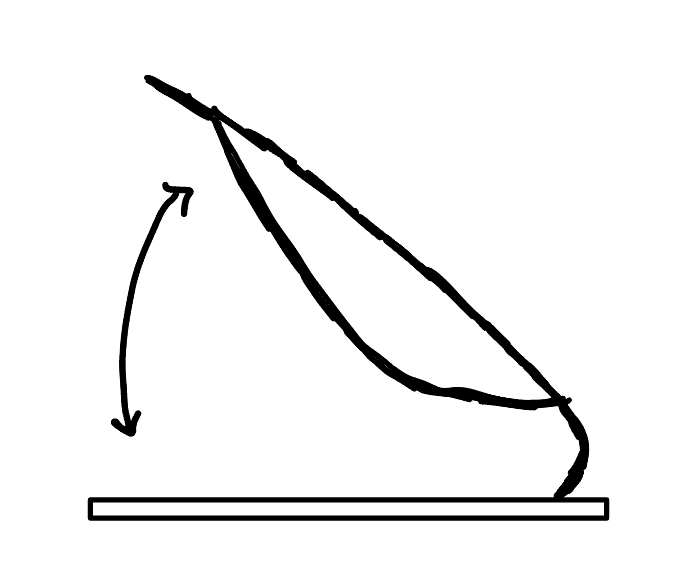
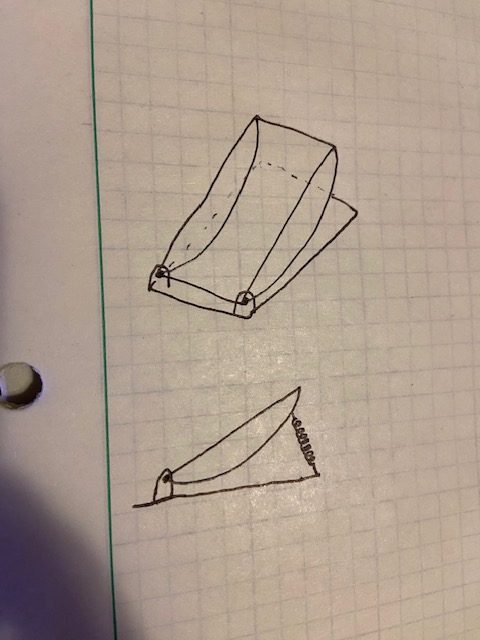
Our second concept is similar to the previous adaptive rocking chair mentioned by Mrs. Martin, while trying to achieve more bouncing than that previous chair by using a spring rather than a damper. This concept would use a single spring in the rear and a hinge at the front. This concept is straight forward and has potential to be light, easily disassembled, and easily scalable by replacing the spring with stiffer springs as the boy grows.
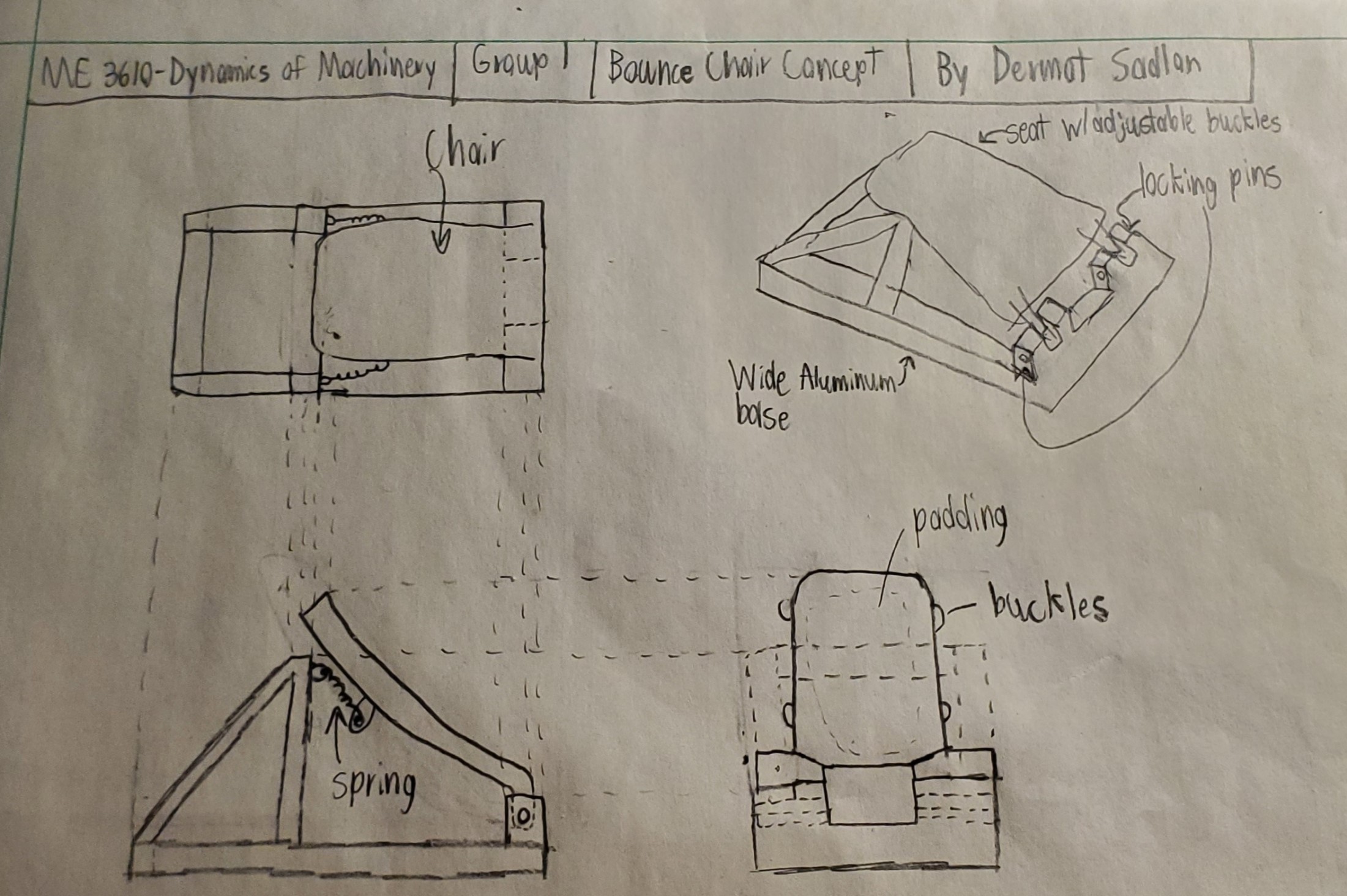
Our third design concept uses a wide base and tension springs to provide the returning force after it is rocked back. The tension springs (one on each side) will be covered with a rubber boot for safety. These springs will be replaceable so the chair can grow with the boy. The seat itself will be pinned into the base with removeable pins, allowing the seat assembly to be broken down into 2 pieces for easier transportation and possibly allowing larger seats to be added in the future. Adjustable buckles will also be used for added safety and comfort.
Design concepts 2 and 3 are both very similar in many ways, with concept 3 being slightly more complex but also slightly more scaleable. We will discuss both of these options with the family more before coming to a conclusion on exactly which one to use. We think that the use of tension springs in concept 3 will be preferrable to the compression springs of concept 2, but the added complexity to manufacture design 3 may not be necessary for the family’s needs.

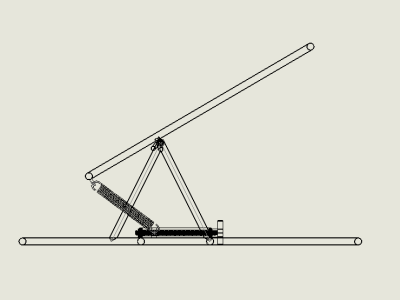
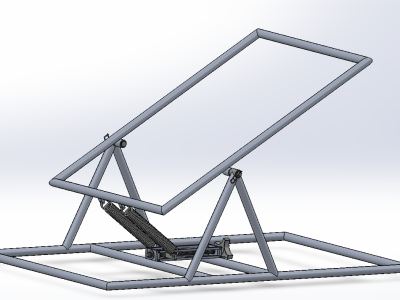
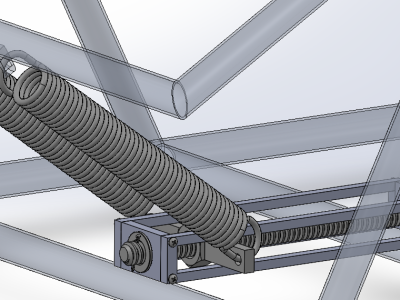
Our selected design uses the tension springs from our concept 3 with a lead screw to pretension the springs from the bottom. The springs where also moved below the front of the seat for a simpler frame design. This will give us the desired bouncing motion while keeping the chair self-contained and facilitating easy disassembly and transportation.

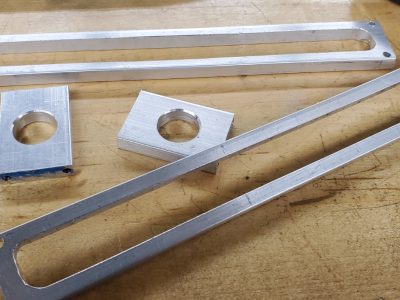
The spring selection was made taking into account both the current and projected weight of the boy while also maintaining a reasonable bouncy natural frequency. The lead screw adjuster allows the pretension to be adjusted as the boy grows so that the desired 30 degree resting inclination can be maintained while preserving the comfortable natural frequency. The lead screw is mounted in billet aluminum with nylon sleeve bearings for low-friction rotation. The lead nut has welded wings which ride in a low-friction polyethylene lined channel of billet aluminum and allows two tension springs to be mounted in parallel. This is all actuated using an ergonomic knob allowing for tool-free adjustment.
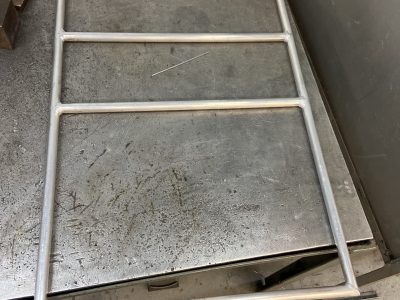
The frame is welded 3/4″ x 0.065 aluminum tube that is plenty rigid while keeping the total weight under 5 pounds. The base extends beyond both ends of the seat to keep the chair stable as he is bouncing. The base will also have rubber feet on the corners to prevent the base from walking as he bounces and keep the aluminum from scratching any hard flooring.
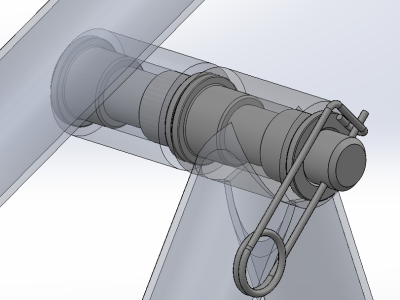
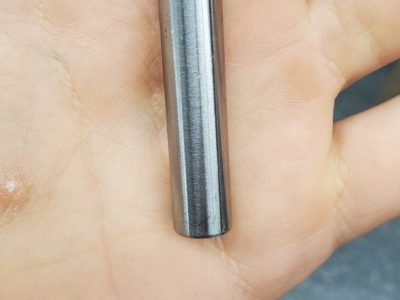
The seat’s pivot is a simple axle riding on multiple nylon sleeve bearings mounted inside aluminum housings. The axle assemblies are easily disassembled by removing the reusable wire-snap pin and sliding the axle out, which allows for the quick separation of the seat from the base.
The seat will be custom sewn with a soft liner and buckles. It will take a hammock-like form that will be comfortable even as he grows. The fabric will slide over the seat frame like a pillowcase and buckle at the bottom. This will allow the seat to be removed and washed as needed.


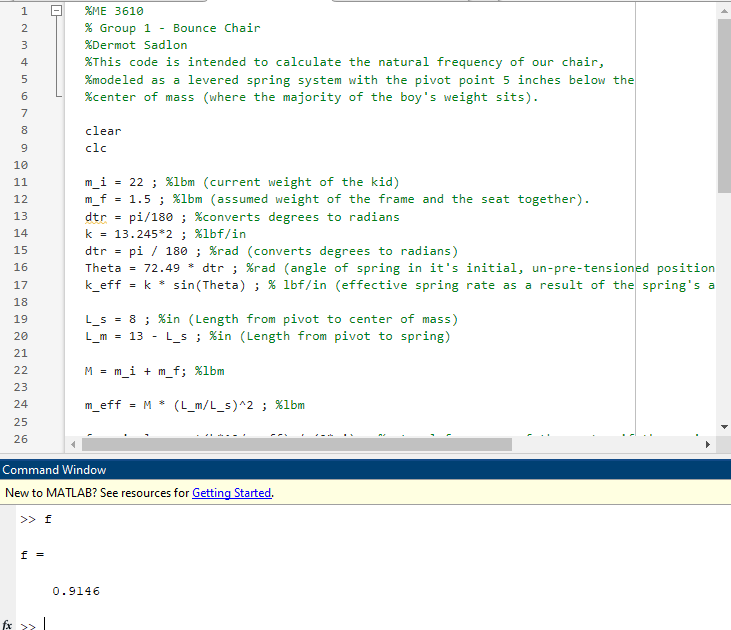
In this analysis, we wanted to verify that our spring rate would be acceptable by analyzing the natural frequency of the spring system. Natural frequency is the rate at which a spring system wants to oscillate when exposed to outside forces. This is important for the comfort and safety of the child, as too high a natural frequency could cause the seat to move rapidly and shake him up. In this code, the natural frequency is calculated using the effective mass (determined using the ratio of lengths from the spring to the fulcrum and from the center of mass to the fulcrum). The effective spring rate is also calculated using the sin of the angle at which the spring acts on the seat frame. The spring rate is determined to be roughly 1Hz. Since a slow rate of oscillation is desired, this is considered to be acceptable, and the selected spring rate’s use is justified.
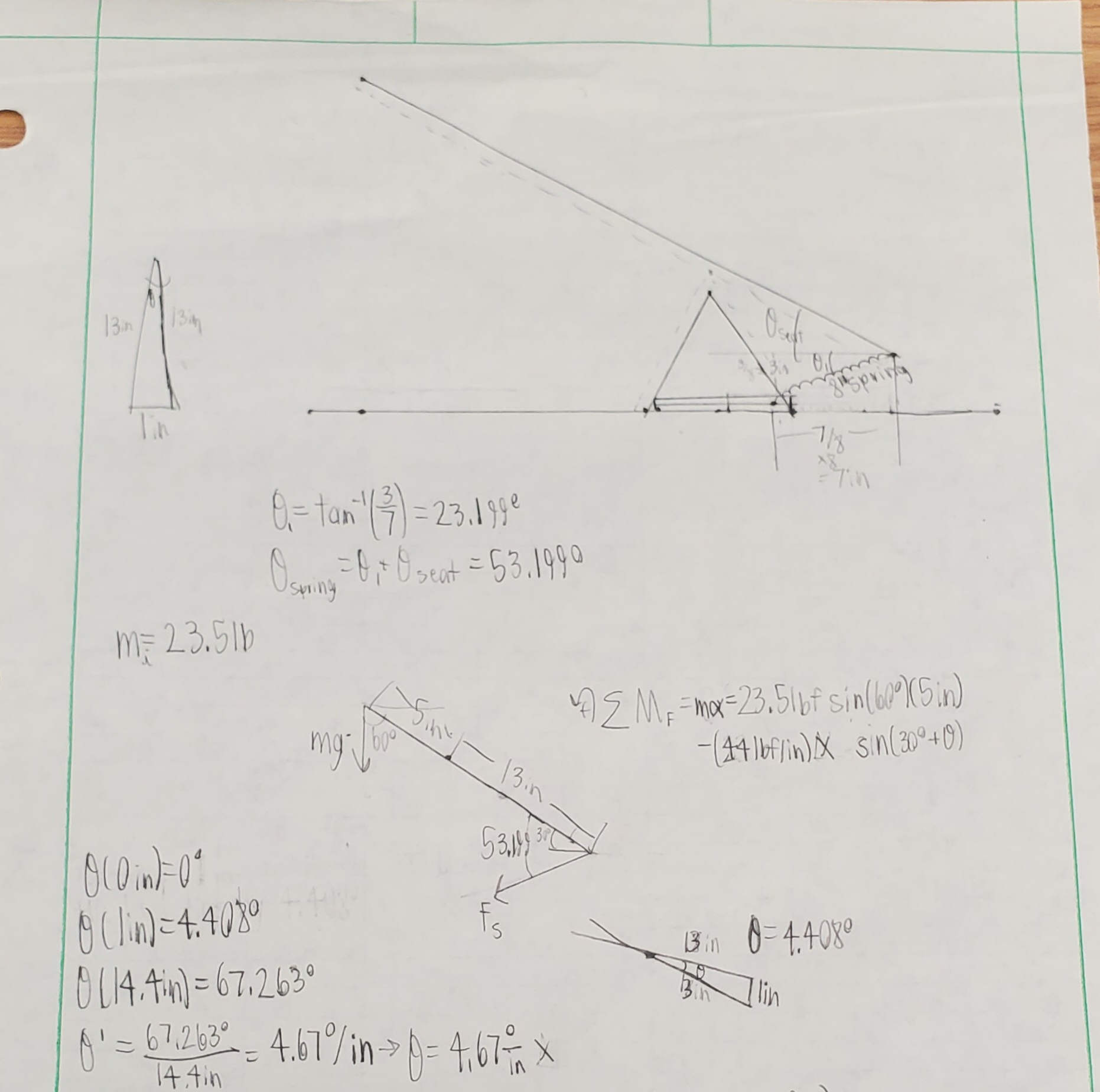
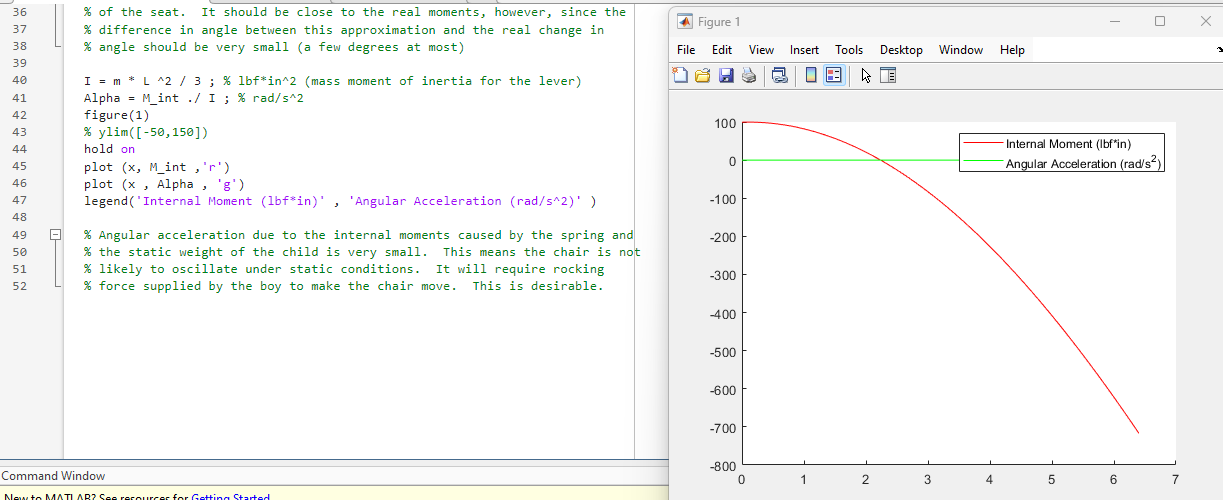
For our third MATLAB script, we analyzed the sum of moments about the fulcrum point of the seat. After approximating the angle at which the spring acts and how that rate varies as the spring stretches (done on paper), we generated a graph to find the internal moment in the system, as well as the angular acceleration, both as functions of the stretch in the spring. The angular acceleration at any given point is near zero, meaning there is very little acceleration due simply to the internal forces in the system, and an external rocking force (generated by the boy) will cause all meaningful rocking motion. We also determined approximately how much preload will be needed on the spring as the child grows. The zero point of the generated graph is the amount of spring preload that will be necessary for the mass of the system. After inputting several spring rates found on McMaster-Carr’s website (as well as changing the boy’s weight), it was decided that a spring rate of 13.245 lbf/in was most acceptable to us. We then went back and re-ran the previous two analyses again with this spring rate in the code.
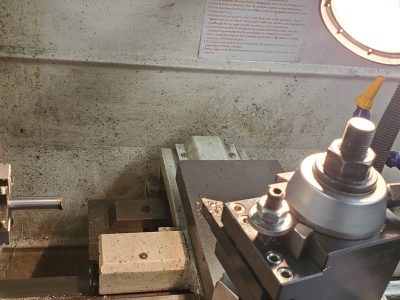
We started by welding the seat frame together. After this was accomplished, this seat frame was taken to have its cloth seat sewn together. In the meantime, the axles were cut on the lathe, the screw channel was built on the mill, and the main frame itself was welded together and prepped to receive the smaller components.